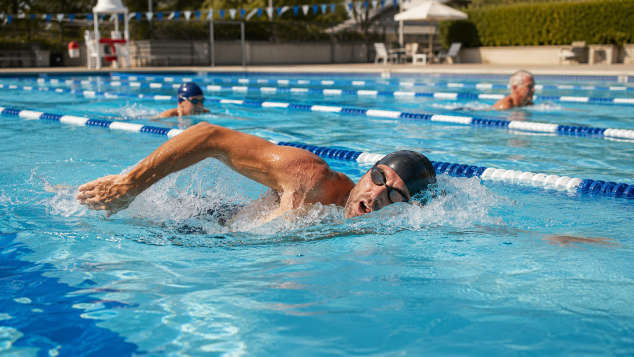
Swimming combines low-impact cardio with steady resistance that works the shoulders, back, core, and legs. It is a refreshing way to build strength and endurance while giving the joints a break from running and other high-impact workouts.
Swimming has started to feel exciting again because it solves one of my biggest summer fitness problems: I still want a demanding workout, but I have very little enthusiasm for running on hot pavement or sweating through a crowded gym session. Getting into a cool pool immediately changes the mood. A few relaxed lengths wake up the body, and before long, the workout becomes surprisingly focused. There is something satisfying about moving through the water with no phone nearby, counting laps, controlling each breath, and realizing that a familiar summer activity can deliver serious cardiovascular work.
Is swimming a full-body workout? Absolutely, provided the session involves more than floating between conversations. Freestyle uses the shoulders, upper back, chest, arms, core, glutes, and legs with every stroke cycle. Backstroke challenges many of the same areas while encouraging a different shoulder position and steady hip rotation. Breaststroke adds a powerful sweeping kick and more deliberate chest and arm action. Kicking drills shift attention toward the hips, legs, and abdominal muscles, while pull-focused lengths make the upper body handle more of the workload. Water creates resistance in every direction, so the muscles remain active throughout each movement. At the same time, continuous laps raise the heart rate, making swimming useful for cardio, strength endurance, and general conditioning.
A realistic beginner swimming workout can fit into about 30 to 40 minutes. I would begin with five minutes of easy freestyle or backstroke, moving slowly enough to settle the breathing and loosen the shoulders. Next, spend six to eight minutes swimming short technique-focused lengths with 20 to 40 seconds of rest after each one. Concentrate on relaxed arm recovery, a steady kick, and a long body position instead of chasing speed. Follow that with eight minutes of short cardio intervals. Swim one length at a moderately challenging pace, rest for roughly 30 seconds, and repeat. Beginners who need more recovery can rest for a full minute, while stronger swimmers can complete two lengths before stopping. The distances matter less than maintaining controlled effort.
The second half of the session can include five minutes of kicking with a kickboard or with the arms extended in front, followed by five minutes of pull-focused swimming using an easy stroke and minimal kicking. The kick section builds lower-body endurance and asks the core to keep the body stable. Pulling places more responsibility on the back, shoulders, chest, and arms. Finish with three to five minutes of gentle swimming while breathing slowly and allowing the heart rate to settle. This structure works in short hotel pools, standard community pools, or longer lanes because it is based on time and effort rather than a fixed distance. Someone returning to exercise could shorten each section, while a more experienced swimmer could add extra interval rounds.
The most useful beginner swimming tips usually involve restraint. Sprinting the first few laps tends to turn the rest of the workout into an extended negotiation with the pool wall. A sustainable pace gives the body time to develop rhythm and keeps the stroke from becoming frantic. Breathing out underwater is especially important because holding the breath often creates tension and makes the next inhale feel rushed. I also stop to rest before my technique completely falls apart. Once the head starts lifting, the legs begin sinking, or the arms start slapping the surface, another hard lap rarely helps. Properly fitted goggles make a bigger difference than people expect, since leaking lenses interrupt concentration and encourage awkward head movement. Total distance should increase gradually as breathing control and form become more consistent.
Swimming is also easier on the joints than many high-impact activities because the water supports much of the body’s weight and removes the repeated landing forces associated with running and jumping. The workout can still feel substantial because moving through water requires constant resistance and sustained cardiovascular effort. That combination makes lap swimming appealing to beginners, experienced athletes, older adults, and people easing back into regular activity. Individual needs still matter. Anyone managing an injury, significant pain, or a health condition should choose an appropriate pace and seek guidance from a qualified professional when needed. For general fitness, two swimming sessions per week can help a beginner develop consistency. A third session may be added once recovery feels manageable and the shoulders are adapting comfortably.
The emotional appeal is part of the reason swimming has become one of my favourite summer routines. An outdoor pool on a hot afternoon feels refreshing before the workout has even started. Progress is easy to notice in small, satisfying ways, such as completing another uninterrupted length or reaching the wall without gasping for air. Over time, the breathing becomes calmer and the whole stroke begins to feel less forced. Swimming offers a challenging workout without making summer exercise feel needlessly punishing. That is why I see it as more than a seasonal fitness comeback. It builds cardio capacity, muscular endurance, movement control, and confidence in a format that can remain useful long after the outdoor pools close.
Pros:
- Provides a true full-body workout that engages the upper body, core, glutes, and legs
- Combines cardiovascular exercise with steady muscular resistance
- Places less repetitive impact on the joints than running or jumping workouts
- Works for beginners while remaining challenging for experienced swimmers
- Helps improve breathing control, endurance, and movement coordination
- Feels refreshing and easier to stick with during hot summer weather
Cons:
- Requires access to a suitable pool and scheduled swimming hours
- Technique and breathing can feel frustrating at first
- Chlorine may irritate the skin, hair, or eyes for some swimmers
- Progress can be harder to track without counting laps, time, or distance
- Poor form or doing too much too soon may leave the shoulders fatigued
Bottom Line:
Swimming is one of the most useful summer workouts because it delivers meaningful cardio and muscular endurance without the pounding of many land-based exercises. It has a learning curve, but a simple lap routine performed two or three times per week can become a challenging, refreshing fitness habit that remains worthwhile beyond summer.
Tags:
swimming as a full-body workout, beginner swimming workout, summer swimming fitness, swimming for cardio, low-impact pool workout, beginner lap swimming routine, joint-friendly cardio workout, swimming breathing technique, swimming workout