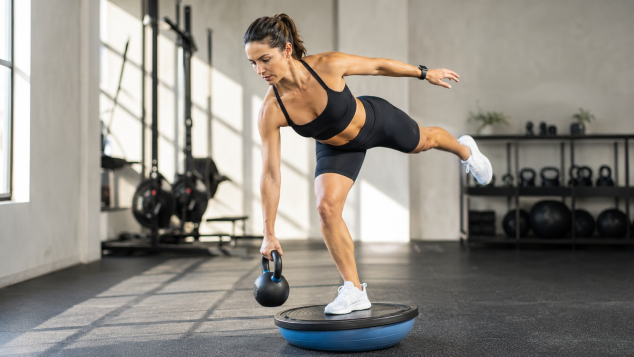
Adding a few focused exercises to your regular workouts can make everyday movement and athletic activities feel more controlled while supporting long-term physical capability.
Balance training has a reputation problem. Plenty of people will happily spend an hour lifting weights or running, then discover during a single-leg exercise that standing still for 30 seconds feels strangely difficult. That was what made me start taking balance work more seriously. The little ankle corrections, hip shifts, and sudden urge to grab the squat rack were a pretty good clue that strength alone was not covering everything. Balance training for adults is essentially practice at controlling your body when your base of support, position, or movement changes. Research in healthy people shows that balance ability responds to training, particularly when the exercises resemble the balance demands you want to improve. Once I started treating balance as a trainable movement skill, giving it a few minutes within regular workouts made a lot more sense.
Good balance depends on your ability to coordinate force and position through the feet, ankles, hips, and trunk while your nervous system keeps track of where your body is in space. That is why balance exercises for adults can complement lower-body strength, core work, mobility, and coordination training so well. Having enough range of motion matters because a stiff ankle or hip can limit the positions available to you, while strength gives you the capacity to control those positions. From a practical standpoint, that control shows up everywhere: landing on one foot while playing recreational sports, adjusting to a rocky section of trail, stepping over something while carrying groceries, or catching yourself after an awkward step. Strength training can contribute to balance, and research in older adults has found improvements in balance following progressive resistance training, although balance remains partly task-specific and benefits from being practiced directly. That combination of strength plus actual balance practice is the approach I prefer.
The most useful place to begin is usually simple single-leg work on solid ground. A single-leg stand teaches you to maintain position while the supporting ankle and hip make constant small corrections; once 20 to 30 seconds feels easy, you can reduce hand support, change your arm position, or add gentle head movement. A single-leg Romanian deadlift takes the same idea into motion, forcing the hip and trunk to control rotation as you hinge. Split squats and rear-foot-elevated split squats build strength in an asymmetrical stance, while step-ups with a slow, controlled knee drive make you finish the repetition balanced over one leg instead of immediately dropping the other foot to the floor. I also like single-leg calf raises because they expose how much foot and ankle control is required to produce force through a relatively small base of support. Single-leg balance practice has been shown to improve balance performance in healthy individuals, which is one reason these drills deserve a place outside rehabilitation settings.
Dynamic exercises make that control more useful. Controlled forward, reverse, or lateral lunges teach you to move into a new base of support and organize yourself once you arrive. Suitcase carries, where you walk with a weight in one hand, make the trunk resist being pulled sideways and turn ordinary walking into a useful offset-loaded stability drill. Heel-to-toe walking can be surprisingly revealing because the narrow stance reduces your margin for error. A foam pad or balance pad can eventually add another challenge by making sensory information from the surface less dependable, and mild uneven-ground work can be relevant for hikers or runners who regularly encounter changing terrain. I would keep those methods in perspective. Research suggests that balance improvements can be quite specific to the tasks being trained, and work on slackline-style unstable training has also found limited transfer to some untrained balance tasks. A wobblier exercise is therefore not automatically a more useful one. I would rather perform a controlled single-leg hinge on the floor than turn every exercise into a circus trick.
For a beginner asking how to improve balance, my preferred balance workout routine is two to four short sessions per week, often attached to the beginning or end of an existing strength workout. That frequency is a practical starting framework rather than a universal prescription. In Session A, do two sets of 20 to 30-second single-leg stands per side, followed by two sets of six to eight slow step-ups per leg with a two-second pause at the top, then two 20- to 30-metre suitcase carries per side. Session B can use two sets of six to eight controlled reverse lunges per leg, two sets of eight to 12 single-leg calf raises with light fingertip support if needed, and two short heel-to-toe walks of roughly 10 to 15 steps. After a few weeks, a third brief session could include supported single-leg Romanian deadlifts for two sets of six to eight repetitions per side and a few short balance-pad holds if solid-ground work already feels controlled. Keep a wall, rack, countertop, or another sturdy object within reach when learning single-leg exercises. If an exercise causes unusual dizziness, significant pain, or repeated loss of balance that feels unsafe, stop and get appropriate medical or rehabilitation guidance.
Progression is where balance training becomes much more interesting. I think of it as moving from a stable two-foot position toward supported single-leg work, then unsupported single-leg positions, controlled movement on one leg, loaded single-leg exercises, and eventually carefully selected uneven or unstable-surface drills. You do not have to rush through that sequence. Make a single-leg stand harder by extending the hold from 20 seconds toward 30 or 45, using less fingertip support, or adding a slow reach. Make a step-up harder by pausing longer at the top or lowering with a slower tempo. Add load to split squats, Romanian deadlifts, carries, or calf raises once body position stays organized. These progressions increase the challenge while preserving useful movement quality. Research on balance training also reinforces the importance of practicing the specific types of control you want to develop, so progression should involve increasingly demanding movement rather than instability for its own sake.
The longevity argument is what finally made balance training feel less like an accessory in my workouts. International and U.S. physical activity guidance specifically emphasizes balance within multicomponent exercise for older adults because maintaining physical function becomes increasingly important with age. That does not mean everyone younger should train as though they are following a fall-prevention program. It gives me a good reason to maintain the underlying skills long before they become obvious limitations. Balance and longevity are connected through physical capability: maintaining strength, coordination, mobility, and the ability to control your body can support independence as you get older. Balance training cannot guarantee that you will avoid falls or injuries, and a one-leg stand is not a crystal ball for future health. Evidence examining single-leg balance as a standalone predictor of fall risk has been inconsistent, which is another reason to avoid overselling a single test. For me, the payoff is much more immediate anyway. My split squats feel more controlled, hiking over rough ground feels more natural, and single-leg work no longer feels like the forgotten corner of fitness. A few focused minutes several times a week is enough to make balance something you actively train instead of something you eventually discover you have lost.
Pros:
- Improves single-leg stability and body control
- Supports ankle, hip, and core strength
- Can help with running, hiking, sports, and strength training
- Makes everyday movements like stairs and awkward steps feel more controlled
- Easy to add to existing workouts in short sessions
- Requires little or no equipment
- Can support mobility, coordination, and long-term physical independence
- Offers plenty of simple progression options as balance improves
Cons:
- Progress can feel slow compared with more measurable strength exercises
- Some drills may seem too easy until performed with proper control
- Highly unstable surfaces can add unnecessary difficulty
- Poor technique can turn balance work into wobbling without much useful training
- Anyone with significant dizziness, pain, or balance problems may need professional guidance
Bottom Line:
Balance training deserves a regular place in an adult workout routine. A few minutes of controlled single-leg exercises, carries, lunges, and step-ups several times a week can build useful stability and coordination without requiring a separate training day.
Tags:
balance training for adults, balance training, balance exercises for adults, how to improve balance, single leg balance exercises, balance exercises for beginners, balance workout routine, single-leg strength exercises, mobility and balance exercises