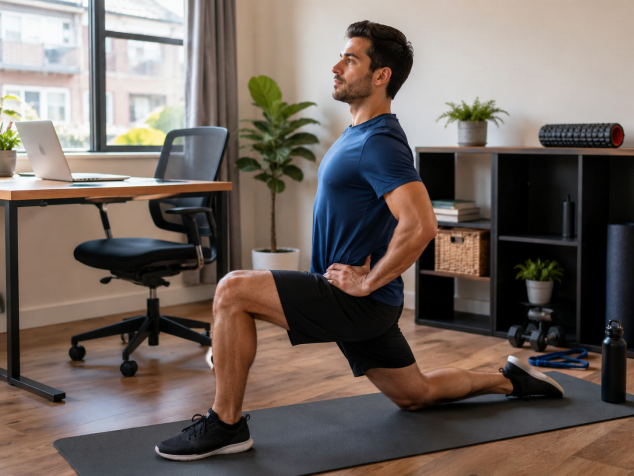
This beginner-friendly routine focuses on tight hips, rounded shoulders, weak glutes, and upper-back strength in a way that actually fits around a desk job.
I used to think a desk worker fitness routine had to be built around getting “more active” in the broadest possible way. More steps, more workouts, more sweating after work. That all helps, of course, but the routine that finally made the most sense for me was much more specific: loosen the hips, wake up the glutes, strengthen the upper back, and stop letting my shoulders live permanently in laptop mode.
The biggest change was admitting that sitting all day creates a predictable pattern. My hip flexors get tight, my glutes get lazy, and my shoulders start rounding forward before I even notice it. A good mobility routine for sitting all day does not need to be dramatic. Mine starts with hip flexor stretches, couch stretches, and thoracic rotations because those movements go right after the places that feel locked up after hours at a desk.
My simple weekly structure is easy to repeat. Three days a week, I do a 25-minute strength routine focused on glutes, core, rows, and upper-back exercises. On workdays between those sessions, I do 8 to 12 minutes of mobility, usually hip flexor stretches, wall angels, band pull-aparts, and a few slow thoracic rotations. That schedule feels realistic because it does not require a full gym mindset every single day.
For glute strengthening for posture, I keep coming back to glute bridges, bodyweight Romanian deadlifts, step-ups, and slow split squats. Glute bridges are especially useful because they teach me to use muscles that sitting seems to switch off. I do two or three sets, focusing on control instead of speed. When my glutes are working better, my lower body feels more stable during regular things like walking, standing, and climbing stairs.
For rounded shoulder exercises, band pull-aparts, face pulls, wall angels, and rows are the movements I trust most. They are simple, but they make me feel like I am undoing some of the forward-folded posture that comes from typing all day. Rows and face pulls are my favorite upper back exercises because they build strength where desk workers usually need it most: between the shoulder blades and across the back of the shoulders.
I also like adding dead bugs and bird dogs because posture support is not only about the shoulders. A stronger core helps me sit, stand, and move with more control. Dead bugs look almost too easy until I slow them down and actually brace properly. They fit perfectly into a beginner-friendly fitness routine because they do not require equipment, and they pair well with glute bridges and mobility work.
What I like most about this routine is that it feels useful in real life. It is not trying to turn every desk worker into an athlete overnight. It gives my body regular reminders to open the hips, strengthen the glutes, pull the shoulders back, and support better posture through strength and mobility. Anyone dealing with ongoing pain, numbness, or an injury should check with a qualified professional, but for a general desk worker routine, this has become one of the most practical fitness habits I have stuck with.
Pros:
- Practical for people who sit at a desk most of the day
- Targets common problem areas like tight hips, rounded shoulders, weak glutes, and a stiff upper back
- Beginner-friendly and easy to do at home with minimal equipment
- Works well as a short routine instead of requiring long gym sessions
- Includes useful posture exercises for desk workers, such as wall angels, band pull-aparts, glute bridges, rows, and hip flexor stretches
- Flexible enough to fit into a weekly schedule without feeling overwhelming
- Focuses on consistency, mobility, and strength rather than quick-fix fitness promises
Cons:
- Results depend on doing the routine regularly
- Some exercises may feel too simple at first for people who prefer intense workouts
- Resistance bands or light weights are helpful for the upper-back exercises
- It may not be enough on its own for people with ongoing pain, injuries, or more serious mobility issues
- Desk workers who sit for very long stretches may still need more walking and movement breaks during the day
Bottom Line:
This desk worker fitness routine is a smart, realistic favorite because it focuses on the areas that actually feel neglected after hours of sitting. I like that it combines tight hip stretches, rounded shoulder exercises, glute strengthening, upper-back work, and simple mobility into a routine that feels useful without being intimidating. For anyone who wants better posture support and a more comfortable body after long desk days, this is a routine worth sticking with.
Tags:
desk worker fitness routine, posture exercises for desk workers, mobility routine for sitting all day, tight hip stretches for desk workers, rounded shoulder exercises, glute strengthening for posture, upper back exercises for posture