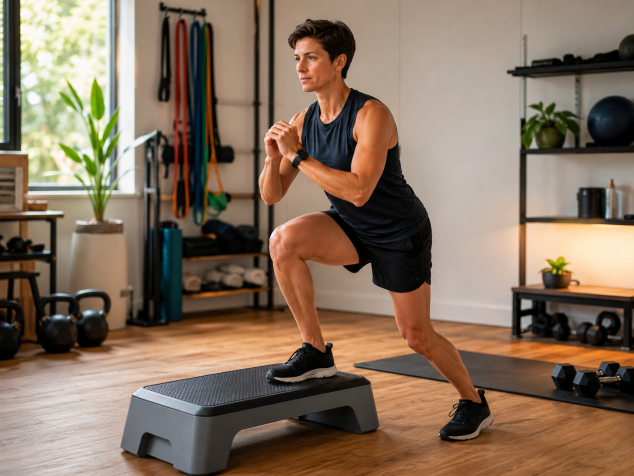
Sensitive knees do not have to end challenging workouts. This practical plan uses controlled strength training, low-impact conditioning, and smart exercise swaps to build fitness while respecting joint limits.
A knee-friendly fitness plan should let you build strength, improve conditioning, and finish a session feeling properly challenged without repeatedly aggravating a sensitive joint. That means adjusting exercise selection, range of motion, impact, and weekly volume while keeping the effort purposeful. I have found that controlled repetitions and sensible exercise swaps make a far bigger difference than simply making every workout easier. Persistent pain, significant swelling, instability, locking, difficulty bearing weight, or symptoms following a recent injury deserve an assessment from a qualified healthcare professional before training continues.
Can you train hard with sensitive knees? In many cases, you can train with real effort by directing that effort toward movements you tolerate well. A knee-friendly workout uses manageable ranges of motion, stable positions, low-impact conditioning, and gradual progression. It also strengthens the hips, glutes, hamstrings, calves, core, and upper body so the program feels complete. Stronger hip and posterior-chain muscles can help you control the position of the thigh and lower leg during squats, steps, hinges, and single-leg exercises. They do not guarantee pain-free knees, although they give you more physical capacity and better control during everyday movement and training. The American College of Sports Medicine recommends regular strength work for all major muscle groups, with two to three sets of eight to twelve repetitions serving as a useful general framework for many adults.
For a beginner, I would use three full training days with at least one recovery day between the harder lower-body sessions. Day 1 begins with five to eight minutes of easy cycling or elliptical work, followed by goblet box squats for 3 sets of 8 to 10 reps, Romanian deadlifts for 3 sets of 8 to 10, banded lateral walks for 2 sets of 10 steps in each direction, glute bridges for 3 sets of 10 to 12, and slow step-downs for 2 sets of 6 per side. Finish with dead bugs for 3 sets of 6 to 8 per side. Rest about 90 seconds after the squats and deadlifts, 45 to 60 seconds after the smaller exercises, and longer whenever your technique begins to slip. The box gives the squat a consistent stopping point, while the Romanian deadlift trains the hamstrings and glutes with less knee movement than many squat or lunge variations.
Day 2 combines upper-body strength, core work, and joint-friendly cardio. Perform an incline dumbbell press for 3 sets of 8 to 12, a seated cable row for 3 sets of 8 to 12, a lat pulldown for 2 sets of 10 to 12, and a seated dumbbell or landmine press for 2 sets of 8 to 10. Add Pallof presses for 3 sets of 8 per side, resting 60 to 90 seconds between sets. Finish with 15 to 25 minutes of cycling, swimming, elliptical work, comfortable incline walking, or technically sound rowing. The pace should feel steady enough that you could continue for a while, with the option to include five or six short harder intervals once your knees tolerate the base session. Low-impact conditioning still allows serious cardiovascular work because intensity can come from resistance, pace, duration, or interval structure rather than repeated pounding.
Day 3 returns to the lower body with hip thrusts for 3 sets of 8 to 10, machine or stability-ball hamstring curls for 3 sets of 10 to 12, supported reverse lunges or supported split squats for 2 sets of 6 to 8 per side, and low step-ups for 2 sets of 8 per side. Add controlled calf raises for 3 sets of 12 to 15 and side planks for 2 sets of 20 to 30 seconds per side. A useful conditioning finish is six sled pushes of roughly 20 to 30 metres with 60 to 90 seconds of recovery, provided the movement is comfortable and the facility has enough space. I prefer keeping the step height modest and using a rack or post for support. Removing the balance struggle makes it easier to concentrate on a slow lowering phase and consistent knee alignment.
Exercise swaps are central to this knee-friendly fitness plan because tolerance varies considerably between individuals. Box squats or goblet squats to a bench can replace deep free squats. Supported split squats or reverse lunges may feel better than forward lunges. Low step-ups can take the place of jumping, while cycling, sled pushes, swimming, or an elliptical can replace running. Romanian deadlifts provide a demanding leg exercise with a hip-dominant pattern, and controlled calf raises can replace repetitive jumping drills. None of these substitutions is universally comfortable, so use the variation that stays smooth and manageable. Stop or modify an exercise that causes significant pain, swelling, or a clear worsening of symptoms rather than trying to force your way through it.
A beginner should progress this joint-conscious workout plan through control and consistency. Start with a range of motion you can manage without twisting, collapsing, or rushing. Use a stable support when learning step-downs and single-leg exercises, then reduce assistance as your control improves. Keep the knee moving in the same general direction as the foot and lower each repetition for roughly two or three seconds. Begin with a load that leaves about two good repetitions available at the end of each set. When you reach the top of the repetition range across every set, and your knees feel no worse later that day or the following morning, add the smallest available amount of weight or slightly increase the range of motion. Avoid sudden jumps in running distance, jumping volume, resistance, or total weekly work. Hard training still needs recovery, and I would rather complete three productive sessions every week than chase one punishing workout that disrupts the next several days.
Pros:
- Allows challenging workouts with less running and jumping
- Builds glute, hamstring, hip, and core strength
- Includes practical swaps for squats, lunges, and high-impact cardio
- Works well for beginners because exercises can be scaled
- Encourages controlled movement and gradual progression
- Provides a complete routine with upper-body training and conditioning
Cons:
- Requires patience when finding comfortable exercise variations
- Progress may feel slower than with aggressive training plans
- Some exercises need equipment such as bands, machines, or a sled
- Sensitive knees may still react differently from one workout to the next
- Poor technique or sudden increases in volume can aggravate symptoms
- Persistent pain or instability may require professional assessment
Bottom Line:
This knee-friendly fitness plan is a strong choice for people who want to train hard while being more thoughtful about joint stress. Its greatest strength is flexibility, since the exercises, range of motion, resistance, and conditioning options can all be adjusted based on individual tolerance.
Tags:
knee-friendly fitness plan, knee-friendly workouts, low-impact strength training, exercises for sensitive knees, beginner knee-friendly exercise, strength training with knee sensitivity, joint-friendly cardio exercises, glute and hamstring exercises