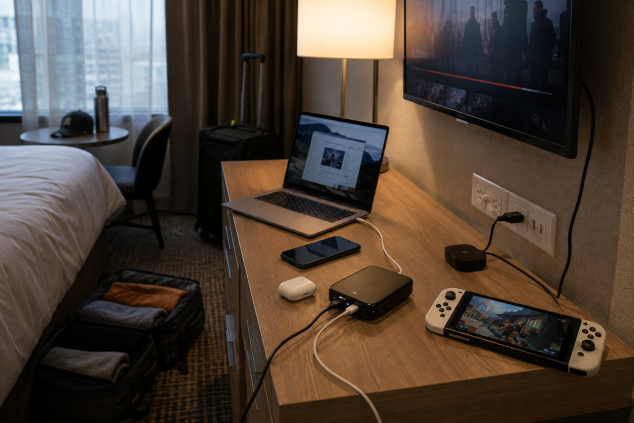
A travel router creates a personal Wi-Fi network for your devices using a hotel’s existing internet connection. It can be especially handy for travellers juggling streaming sticks, gaming devices, tablets, and other electronics.
A travel router sounds like the sort of gadget that earns a suspicious look when you are already trying to fit chargers, cables, and electronics into a carry-on. The idea becomes much more practical once you understand its job. A travel router is a small portable router that takes an existing internet connection, such as hotel Wi-Fi or Ethernet, and creates a personal Wi-Fi network for your own devices. In a hotel, that means your laptop, phone, tablet, streaming hardware, handheld console, e-reader, and other electronics can connect to one familiar network instead of dealing individually with whatever Wi-Fi system the hotel happens to use. That is the main answer to what a travel router does, and it is also the reason I think this little category of travel technology makes considerably more sense than its niche reputation suggests.
The easiest way to picture a travel router for hotels is as a middle layer between your electronics and the hotel's internet connection. You connect the portable travel router to the hotel Wi-Fi, usually through the router's setup interface, and complete any required hotel sign-in using a compatible phone or computer. Once that connection is established, your devices join the private Wi-Fi network created by the router. You can save that network name and password on your electronics ahead of time, so arriving somewhere new does not necessarily mean configuring everything again. Some hotels also provide an accessible Ethernet port. With a compatible router, you can plug in a short Ethernet cable and turn that wired connection into your own wireless network. I especially like the simplicity of that arrangement because the travel router becomes the one device handling the unfamiliar hotel connection while everything else sees a network it already recognizes.
That convenience matters most when you are connecting multiple devices to hotel Wi-Fi. Signing a laptop and phone into a hotel's network is usually manageable. Add a tablet, a streaming stick, a handheld gaming system, and a few other Wi-Fi gadgets, and the process gets irritating fast. Some hotels also limit how many devices can be registered to a room or require guests to repeat an authentication process. A travel router can simplify the local side of the setup by letting those devices communicate through its own network, although hotel policies and device limits can still vary. For someone carrying only a phone and laptop, this benefit may feel minor. For someone whose hotel desk tends to turn into a temporary electronics station, having one familiar network starts to earn its place in the bag.
The biggest headache a hotel Wi-Fi router can help with is the captive portal, which is the browser-based sign-in page that often appears after you connect to hotel Wi-Fi. Phones and laptops generally handle these pages well because they have full web browsers. Streaming sticks and portable game consoles can be much less cooperative. A device might connect to the Wi-Fi signal while giving you no convenient way to enter a room number, accept terms, or complete another browser-based step. With a compatible travel router, you can establish the hotel connection through a device that handles the login properly, then put your harder-to-connect electronics on the router's personal network. That makes a travel router for streaming particularly appealing if watching your own services on a hotel TV is part of how you travel. The same logic applies to a travel router for gaming when a handheld console struggles with a hotel's authentication page.
Privacy deserves a little more care because travel routers sometimes get discussed as though plugging one in magically turns public Wi-Fi into a fortress. A router can give you a network you control and keep your own devices behind that local network, which is useful. It does not automatically make everything happening on the hotel internet connection private. Modern encrypted websites and apps already provide important protection for data in transit, and good device security still matters. Some portable routers also support routing traffic through a VPN when used with a compatible VPN service, which can add another layer of privacy depending on how the router is configured. I would treat travel router VPN support as a useful capability rather than a reason to become careless about unfamiliar networks.
There is also a slightly nerdier reason I find portable routers interesting: the category keeps picking up technology that once belonged mainly in full-size home networking gear. Newer portable-router designs are beginning to incorporate standards such as Wi-Fi 7, alongside increasingly capable processors and more flexible networking features. I would not choose a travel router purely because the box says Wi-Fi 7, especially when hotel internet speed is often the bigger limitation. Still, the arrival of Wi-Fi 7 travel router hardware shows how far these devices have moved beyond being bare-bones accessories for frequent business travellers. They are becoming surprisingly capable little networking boxes that happen to fit in a travel pouch.
The accessories are where I would keep things deliberately minimal. A compact USB-C power adapter makes sense when the router requires external power, and a short USB-C cable prevents the setup from turning into a knot of excess cord on a hotel nightstand. A compact Ethernet cable is worth adding if you specifically want the option of using wired hotel internet. If streaming is part of the reason you are carrying the router, the streaming stick still needs whatever power cable it requires, and a small HDMI extender or adapter can be useful because hotel TV ports have a talent for appearing in awkward places. I would keep those pieces with the router in a small organizer rather than scattering them throughout a suitcase. Someone who never streams and has no interest in Ethernet can leave those extras at home. The useful travel-router kit is the one tailored to the electronics you actually carry.
So, do you need a travel router in a hotel? For plenty of travellers, no. A phone and laptop can usually connect directly to hotel Wi-Fi with little drama, and carrying another powered device simply creates more setup. I think the equation changes quickly once several Wi-Fi devices come along, particularly streaming hardware or gaming devices that do not always play nicely with hotel captive portals. Frequent hotel guests can also benefit from giving their electronics one familiar network wherever they go. That is why a portable Wi-Fi router for travel has gone from sounding excessive to seeming quite sensible to me. It solves a very specific annoyance, and for travellers whose bags already contain a miniature collection of connected electronics, that annoyance comes up often enough to matter.
Pros:
- Makes connecting multiple devices to hotel Wi-Fi much easier.
- Creates a familiar personal Wi-Fi network for your electronics.
- Can simplify captive-portal logins for streaming sticks and gaming devices.
- Some models can turn a hotel Ethernet connection into a private wireless network.
- May support VPN connections for added privacy when configured with a compatible VPN service.
- Compact enough to fit into a small travel-tech pouch.
Cons:
- Adds another device, charger, and cable to your luggage.
- Requires some initial setup and basic networking knowledge.
- Hotel captive portals can occasionally make the connection process awkward.
- Cannot improve a hotel internet connection that is already slow or unreliable.
- Privacy benefits depend on the router's features and how it is configured.
- Offers limited value if you usually travel with only a phone and laptop.
Bottom Line:
A travel router is worth considering if you regularly stay in hotels with several connected devices, especially streaming hardware or portable gaming systems. For light travellers who mainly use a phone and laptop, the convenience probably will not justify carrying another gadget.
Tags:
travel router, what is a travel router, what does a travel router do, travel router hotel WiFi, portable WiFi router for travel, travel router for hotels, hotel Wi-Fi, portable travel router, connecting multiple devices to hotel Wi-Fi, travel router