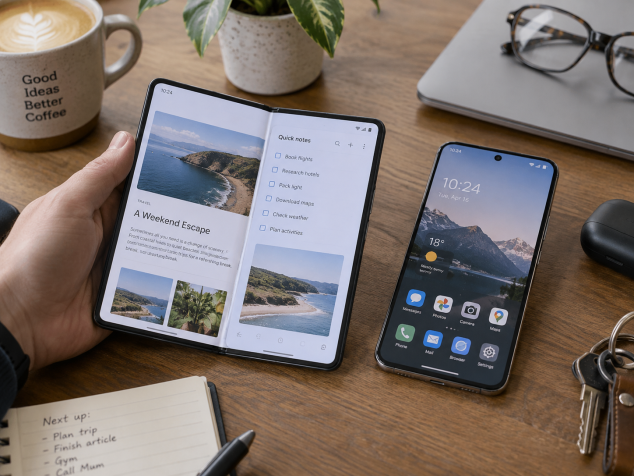
Foldable phones are thinner, tougher, and more useful than earlier models, but they still come with tradeoffs in durability, battery life, cameras, and accessories.
Foldable phones have finally reached the point where I can imagine recommending one as somebody’s only phone without immediately running through a list of warnings. They are practical enough for everyday use in 2026, provided the person buying one has a clear reason for wanting the folding design. A regular smartphone remains the easier recommendation for the average buyer because its simpler construction, predictable battery life, mature accessory ecosystem, and conventional display remove several ownership concerns. Foldables are clearly moving closer to the mainstream, though. Counterpoint Research expects cumulative global foldable smartphone shipments to pass 100 million units by the end of 2026, even though the category still represents only about 2% of the overall smartphone market. Apple has also entered the category, unveiling the foldable iPhone Duo on September 9, 2026, which should expose far more shoppers to the idea of carrying a phone that opens into a larger screen. Those developments make the foldable phone vs regular phone question much more relevant. The decision now comes down to whether the folding screen improves the things you already do on a phone enough to justify living with a hinge, flexible display, and unusual dimensions every day.
There are two main approaches to the foldable smartphone. A book-style foldable looks roughly like a thick conventional phone when closed and opens sideways to reveal an inner display approaching small-tablet territory. A flip-style foldable takes a normal phone-sized screen and folds vertically into a shorter shape that can be much easier to fit into a jacket pocket or small bag. Regular smartphones keep everything on one rigid slab, with a single glass-covered display and no hinge running through the chassis. That familiar design still has practical value. Sliding a regular phone into jeans, pulling it out to answer a message with one hand, mounting it in a car, or quickly checking a map requires almost no thought. A book-style foldable adds a decision to many of those interactions: use the cover screen or open the phone? In practice, I suspect a lot of owners spend more time on the cover display than they initially expect. The inner screen becomes something you deliberately open for reading, video, maps, email, documents, or running two apps together. Flip phones work differently. Their biggest advantage is physical compactness, especially for someone who dislikes carrying a tall phone, while the smaller external display can handle quick notifications and basic controls without opening the device.
Durability is where the foldable smartphone pros and cons become harder to ignore. A conventional phone has fewer mechanical variables. Foldables add a hinge, moving components, and a flexible OLED panel that has to survive repeated bending. Modern hinge designs are far more refined than the early versions, yet foldable phone hinge durability still deserves consideration because dust and debris can find their way into areas a rigid phone simply does not have. The inner screen also needs a softer layered construction than the hard exterior glass people are accustomed to tapping, wiping, and occasionally abusing. Questions about foldable screen lifespan are therefore reasonable even when manufacturers rate their hinges for very large numbers of folds. Real life includes pocket lint, grains of sand, accidental pressure, drops, and someone pressing a fingernail into the display. Water resistance has improved substantially across premium foldables, which makes rain, spills, and normal daily handling less worrying than they once were. Fine particles remain a tougher engineering problem. Then there is the foldable phone crease. You can usually see it when light hits the screen at certain angles and feel it when your finger crosses the fold. Once content is moving on the display, I find the crease much easier to mentally filter out. Anyone expecting a perfectly flat, uninterrupted sheet of glass may continue noticing it.
The physical compromises become more obvious when you carry these phones rather than admire them open on a display table. Book-style models have become impressively thin, yet folding two halves together still creates a device that can feel dense in a jeans pocket. Flip phones solve the height problem when folded while becoming thicker in one spot, which changes how they sit in tighter clothing. Battery packaging is another challenge. A hinge consumes valuable internal space, and the chassis has to accommodate separate sections around the fold, so foldable phone battery life can involve compromises compared with similarly priced regular flagships that have more straightforward room for large batteries. The same packaging issue affects foldable phone camera quality. Camera modules take up considerable space, particularly when manufacturers want larger sensors and sophisticated zoom hardware. A premium slab phone can devote more internal volume to that camera system without also engineering a folding mechanism and second display. Foldable cameras have become very capable, and most people can get excellent everyday photos from them. Someone who routinely buys a top flagship specifically for the strongest available zoom or camera hardware should compare carefully before switching. At foldable prices, “good enough” can feel less convincing when a conventional phone beside it offers a stronger camera package.
The larger inner screen is still the strongest argument for choosing a book-style foldable. Checking a transit map while commuting feels better when more streets are visible. Reading a long article or email requires less scrolling. Watching video while travelling gives you substantially more usable screen area without carrying a separate tablet. Multitasking is where the advantages of foldable phones become especially tangible. Having a browser open beside notes, checking an address while keeping a message thread visible, or working between email and a document feels much less cramped than split-screen multitasking on a normal phone. Software support matters just as much as the hardware. Operating systems have become better at taskbars, app pairs, flexible window layouts, and moving content between cover and inner screens, although individual apps can still behave awkwardly on unusual aspect ratios. Some simply stretch. Others place controls in strange locations or waste much of the extra space. One-handed use also exposes an important reality about foldable phone everyday use: the big screen is useful when you intentionally want it. For a quick reply while walking or checking something with one hand on a commuter train, the cover screen often remains the practical choice. Anyone considering a foldable should ask how frequently they would genuinely open it during an ordinary day.
Foldable phone accessories deserve much more attention than they usually receive in comparisons because they can change the experience substantially. A regular smartphone has an enormous choice of thin cases, rugged cases, glass screen protectors, magnetic mounts, charging stands, grips, wallets, and vehicle accessories built around a predictable rectangular shape. Foldable cases are trickier. Many use separate pieces for each half, while more protective designs add hinge coverage that increases an already thick device’s bulk. A slim case preserves the reason manufacturers worked so hard to reduce thickness, although it leaves the hinge more exposed. A rugged option can make a book-style foldable feel noticeably larger in a pocket. Inner-screen protectors also need to flex with the display, so replacing or removing them deserves more care than peeling tempered glass from a conventional phone. Wireless charging can work perfectly well, yet case thickness, camera bumps, and the position of charging coils can affect how neatly the phone sits on certain stands. Portable power banks and flat charging pads are usually easy enough to use. Car mounts can be more awkward because a folded device may be unusually thick, while opening a book-style phone makes it too wide for some standard clamps. Grips and kickstands are genuinely useful for larger foldables, particularly when watching video, and stylus support on compatible models can make the inner display more productive. Every accessory that adds protection also risks making the phone feel less elegant to carry.
Repair anxiety remains one of the strongest disadvantages of foldable phones. Dropping a conventional flagship can already produce an expensive repair bill, yet replacing a large flexible display or damaged folding mechanism has the potential to cost considerably more. That changes how comfortable I would feel carrying one without a case, tossing it into a bag with other objects, or using it somewhere dusty. Extended coverage or accidental-damage insurance makes more sense to me on a foldable than on almost any other type of phone. The regular slab still wins for the person who treats a phone as a tool that should tolerate several years of careless pockets, crowded commutes, car-console drops, kitchen counters, and constant one-handed handling. Foldables require a little more awareness. That does not mean they are fragile novelty devices. Current designs are built for daily opening and closing, and the category has accumulated enough real-world use that durability feels far less experimental than it once did. The underlying engineering simply remains more complicated. When people ask are foldable phones durable, my answer is yes for ordinary daily use, with a higher financial consequence if something does go wrong.
So, are foldable phones worth it? I think they finally can be. A book-style foldable makes the most sense for someone who reads heavily on a phone, works between apps, watches plenty of video while travelling, relies on maps, or regularly wishes their smartphone screen were closer to a small tablet. A flip-style device suits someone who values a compact folded shape and likes handling quick tasks from an external screen. For everyone else, the best phone type for everyday use is still likely to be a regular smartphone. You get a thinner and usually lighter device, simpler case choices, fewer mechanical concerns, and often stronger cameras or battery endurance for the same money. Foldables have crossed an important practical threshold: buying one no longer feels like volunteering to beta-test a form factor. Their extra complexity needs to earn its place in your pocket, though. If you can already picture yourself opening that larger display several times every day because it would make specific tasks easier, a foldable has become a credible everyday replacement. If the folding screen mainly looks impressive in the store, a good conventional phone will probably remain easier to live with.
Pros:
- Larger inner screens are genuinely useful for reading, maps, video, email, and multitasking.
- Book-style foldables can replace some of the functions of a small tablet.
- Flip-style foldables are easier to carry in a jacket pocket or small bag.
- Modern hinges and flexible displays are much more refined than earlier generations.
- Cover screens let you handle quick tasks without unfolding the phone.
- Foldables now feel practical enough for normal daily use.
- Some models support styluses, stands, and productivity-focused accessories.
Cons:
- They are usually thicker and heavier than regular smartphones.
- The screen crease is still visible and can sometimes be felt.
- Hinges and flexible displays add more potential wear points.
- Battery life can be weaker than similarly priced conventional phones.
- Camera hardware may involve compromises because internal space is limited.
- Repairs, especially flexible display repairs, can be expensive.
- Protective cases often add noticeable bulk.
- Car mounts, wireless chargers, grips, and screen protectors can be less straightforward to choose.
- Some apps still do not make ideal use of unusual screen sizes.
- Regular phones remain easier to use one-handed.
Bottom Line:
Foldable phones are finally practical enough to use as an everyday phone, especially for people who will regularly take advantage of the larger display or compact flip design. For most buyers, though, a regular smartphone still offers the simpler and more dependable ownership experience, with better portability, easier accessories, and fewer durability concerns.
Tags:
foldable phone vs regular phone, are foldable phones worth it, foldable phone durability, foldable screen lifespan, foldable smartphone pros and cons, foldable phone crease, foldable phone battery life, foldable phone camera quality