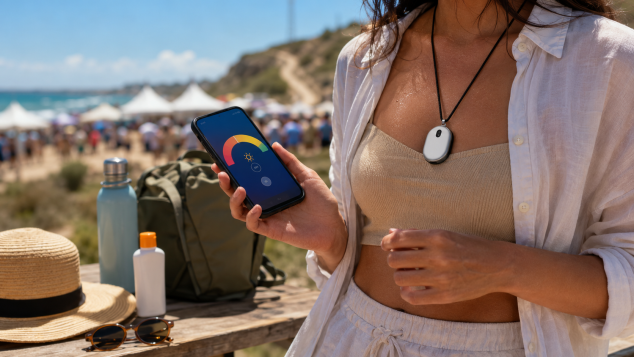
Wearable UV trackers can monitor cumulative sun exposure and send personalized alerts during beach days, hikes, festivals, or everyday time outdoors.
Sun exposure has a quiet way of adding up when the day is going well. I can leave home for an outdoor concert or a long patio lunch, then spend another hour walking around without thinking much about how long my face, neck, and arms have been in direct sunlight. A weather app might have warned me that the UV index was high that morning, yet it cannot keep track of every shaded table, sunny trail, or open festival field I move through. That gap is what makes the wearable UV tracker such an interesting piece of summer wearable technology. It brings sun exposure tracking closer to the person actually wearing it.
A wearable UV tracker is a compact sensor designed to detect or estimate the ultraviolet radiation reaching the wearer during the day. Depending on the device, it may measure both UVA and UVB exposure, maintain a record of cumulative exposure, and send the information to a companion smartphone app through Bluetooth. The app can combine those readings with details such as skin sensitivity, clothing coverage, sunscreen use, and personal preferences. Instead of showing one general UV forecast for an entire area, a wearable sun sensor can provide personalized UV alerts based on the conditions around the user. UVA rays are associated with premature skin aging and can pass through window glass, while UVB rays are the main cause of sunburn, which explains the value of tracking both forms of exposure.
Gem by The90 offers a timely example of where this category may be heading. TechRadar described it as a “personal sun intelligence system,” housed in a pendant-style wearable that measures UVA and UVB exposure and communicates with a companion app. The removable sensor module contains the UV sensor, an accelerometer, and Bluetooth hardware, while a titanium pendant housing allows it to be worn as jewellery. The confirmed package and system also use a proprietary magnetic charger with a provided USB-C cable. This approach makes the UV exposure monitor feel closer to an everyday accessory than a piece of outdoor testing equipment.
The most convincing reason to wear a UVA and UVB tracker is the possibility of receiving a useful prompt at the moment a decision still matters. During a beach day, a personalized alert could remind someone to check whether sunscreen needs reapplying after swimming. On a hike, it might encourage a break under tree cover when an exposed section of trail lasts longer than expected. At a festival, the same information could lead to adding a hat, covering exposed shoulders, or shortening time in an unshaded area. These alerts should support established sun-protection habits rather than override product directions. Dermatologists generally advise reapplying sunscreen about every two hours outdoors and after swimming or sweating, while public-health guidance also recommends shade and clothing that covers exposed skin.
Wearability will have a major influence on whether these sensors become regular summer gear. A pendant works well when it sits openly near the chest, though some people may prefer a clothing clip, watch attachment, bag strap mount, or lanyard. Interchangeable chains and sensor holders could make one device easier to move between everyday clothing and hiking gear. A protective case would help during travel, while a charging dock and small storage pouch could prevent the sensor from disappearing into the bottom of a beach bag. These accessories should be checked product by product because many are possible formats rather than standard inclusions. The90’s current manual describes Gem as a modular sensor designed for future form factors, including a planned clip, which shows how adaptable attachments may broaden the category’s appeal.
Anyone considering a UV tracker for outdoor activities should look beyond the shape of the wearable. Battery life needs to cover a full outing without frequent charging. Water resistance should match the intended use, especially around pools, ocean spray, sweat, and sudden rain. The current Gem is described as splash-proof rather than submersible, for example, so it must be treated differently from a waterproof sports watch. Buyers should also check smartphone compatibility, Bluetooth reliability, app update support, sensor placement requirements, and whether sunscreen residue can interfere with readings. Gem’s manual instructs users to keep its quartz sensor window clear of thick sunscreen, lotion, and oil, which is the kind of maintenance detail that could easily be overlooked.
Accuracy and notification quality matter just as much as the hardware. A device that sends vague warnings too often may be ignored within a week, while alerts that arrive late offer limited practical value. It should be clear whether the wearable directly measures UVA and UVB, estimates exposure from another signal, or blends sensor readings with regional weather data. Users should also understand how the app calculates personal thresholds and what information it stores. A sun-exposure profile may contain skin characteristics, location data, sunscreen habits, and daily routines, so privacy controls and deletion options deserve attention. A UV tracker remains a consumer awareness tool. It cannot diagnose skin damage or replace sunscreen instructions, protective clothing, medical advice, or personal judgment.
I can see a wearable UV tracker becoming genuinely useful for travellers, hikers, festival regulars, and anyone who already pays attention to skincare. The strongest versions will fit naturally into clothing, remain comfortable during long days, and translate cumulative exposure into alerts that are easy to act on. I would still pack sunscreen, a hat, and something to cover my shoulders before leaving home. The sensor would serve as the reminder I am likely to appreciate several hours later, when an enjoyable summer afternoon has quietly turned into a much longer stretch in the sun. That makes wearable sun-exposure technology worth watching and gives it a realistic chance of joining the standard summer gear pile.
Pros:
- Tracks cumulative sun exposure throughout the day
- Personalized UV alerts may support better sunscreen and shade timing
- Useful for beach days, hiking, festivals, travel, and outdoor events
- Wearable formats can fit into clothing, jewellery, or outdoor gear
- Companion apps may provide clearer exposure trends than a general UV forecast
Cons:
- Accuracy can depend on sensor position and keeping the sensor uncovered
- Water resistance, battery life, and phone compatibility vary by device
- Frequent or poorly timed notifications may become easy to ignore
- Some apps may collect sensitive location or personal skincare information
- A UV tracker adds another device that needs charging, cleaning, and carrying
Bottom Line:
Wearable UV trackers are a promising summer technology for people who spend plenty of time outdoors or take sun protection seriously. They work best as awareness tools that support sunscreen, protective clothing, shade, and personal judgment rather than replacing established sun-safety habits.
Tags:
wearable UV tracker, UV exposure monitor, wearable sun sensor, personalized UV alerts, UVA and UVB tracker, summer wearable technology, sun exposure tracking, UV tracker for outdoor activities, smart sun protection, UV sensor pendant