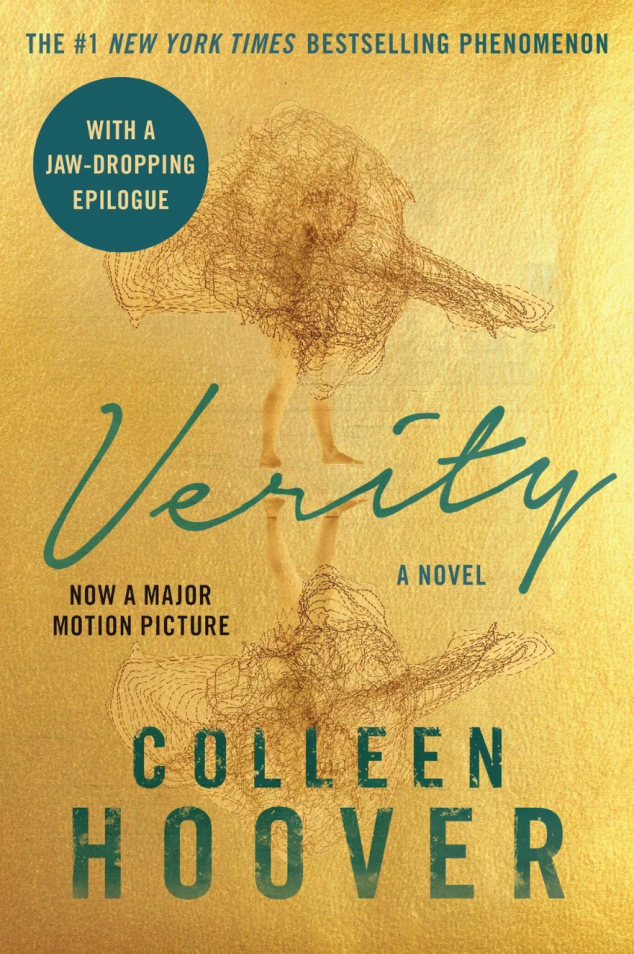
Colleen Hoover’s Verity turns a private manuscript into something that feels like evidence, showing how quickly written words can shape belief.
One of the strangest things about Verity by Colleen Hoover is how much damage begins with an act that looks completely ordinary: someone reads something. Lowen Ashleigh discovers writing she arguably was never supposed to see, and from that point forward, words start behaving almost like physical evidence. The private manuscript changes how she interprets Verity Crawford, how she looks at Jeremy Crawford, and how she understands the increasingly uncomfortable house she has entered. That is what stayed with me most after finishing the Verity book. Its central threat is tied to the frightening amount of authority we give a document once we believe the person who wrote it was telling the truth.
Writing is already embedded in the premise long before the manuscript complicates everything. Lowen enters Verity Crawford's life because she has been hired to complete the bestselling author's unfinished series. Ghostwriting in Verity therefore begins as a professional exercise in imitation. Lowen needs to understand how another writer constructs stories well enough to reproduce a version of that public voice. There is something wonderfully uncomfortable about what happens next. While searching through Verity's notes and materials, Lowen encounters a supposedly private voice that feels far more intimate than anything intended for publication. Her professional task involves studying the stories Verity wanted readers to see, while her attention is gradually captured by writing that appears to reveal what Verity never wanted anyone to know.
The importance of the Verity manuscript comes from the way it presents itself as evidence. Autobiographical writing carries a peculiar sense of authority because readers naturally assume that specificity signals honesty. If someone describes an ugly memory in careful detail, names their motives, and admits to thoughts that make them look terrible, the confession can feel especially convincing. Why would anyone invent something so damaging about themselves? That assumption becomes one of the engines of the Verity psychological thriller. Lowen does not simply read a disturbing story. She begins reorganizing her understanding of real people around it. The manuscript represents the danger of confusing narrative confidence with factual certainty. A document can sound sincere, coherent, and intimate while still leaving the reader with no independent way to verify what actually happened.
That uncertainty becomes more interesting once the boundaries between autobiography and fiction start to blur. Readers instinctively respond differently to the sentence "this happened to me" than they do to "here is a story I invented," even when both sentences come from the same writer. The genre label changes the weight we assign to the words. That tension sits at the center of the truth and fiction in Verity. The manuscript appears autobiographical, so Lowen approaches its contents with the seriousness of testimony rather than the distance she might bring to a novel. Yet Verity Crawford is also a professional fiction writer, someone whose job involves creating convincing motives, emotional detail, and believable characters. The Verity autobiography therefore occupies an uneasy space where the reader keeps wondering how much the form itself is influencing the verdict.
I find Lowen's reaction especially revealing because she should understand narrative construction better than almost anyone. She writes for a living. She knows writers choose what to include, what to emphasize, and where to direct a reader's attention. Even so, she becomes deeply influenced by another writer's version of events. Jeremy is affected by what Lowen learns and shares as well, which gives the written material consequences far beyond private interpretation. Meanwhile, the person at the center of the document has limited ability to contest the narrative surrounding her. In that sense, writing influences the characters in Verity by creating a version of reality that begins to compete with direct observation. The manuscript effectively speaks for Verity even when Verity herself cannot provide a normal explanation.
This is also where unreliable narration in Verity becomes more complicated than simply deciding whether a narrator is lying. The deeper uncertainty concerns interpretation. Lowen reads the manuscript, draws conclusions from it, notices things around the Crawford home through the lens it creates, and the reader experiences much of that unease alongside her. Once a disturbing explanation has entered your head, seemingly unrelated behavior can begin to support it. That makes the manuscript one of the most important Verity themes: written words do not merely communicate information, they can establish the framework through which later information is judged. The novel quietly makes the reader participate in that process. We receive a document, mentally classify it, and then start deciding what it proves.
That is why my own Verity book review keeps circling back to the manuscript rather than any single shock in the plot. The device gives Colleen Hoover's Verity an idea worth arguing about after the suspense has faded. A private piece of writing can function as confession, performance, self-examination, invention, or some unstable mixture of those forms. The problem is that readers rarely approach a document without assumptions about what kind of document it is. My lasting Verity analysis is therefore less concerned with whether every written claim can be solved cleanly and more interested in why we want written claims to settle things for us. Verity made me considerably more suspicious of the authority of a page. Someone writing something down can make it feel permanent, deliberate, and true. None of those qualities, on their own, make it evidence.
Pros:
- The manuscript gives Verity a distinctive psychological hook centered on writing, belief, and interpretation.
- Lowen’s role as a writer makes her vulnerability to another writer’s narrative especially interesting.
- The blurred line between autobiography and fiction creates lasting uncertainty without requiring constant plot twists.
- The novel raises a compelling question about why readers often treat detailed personal writing as inherently truthful.
- Ghostwriting adds another layer to the story by contrasting Verity’s public authorial voice with her supposedly private one.
Cons:
- The manuscript can feel so dominant that other parts of the novel receive less thematic attention.
- Some readers may find the ambiguity frustrating if they prefer a thriller with a clearly established truth.
- Lowen’s willingness to trust what she reads may occasionally feel too quick, especially given her own experience as a writer.
- The novel relies heavily on the reader accepting that written testimony can reshape how characters interpret almost everything around them.
Bottom Line:
The strongest idea in Verity is that writing itself can become dangerous when readers mistake narrative authority for proof. The manuscript works because it influences Lowen, Jeremy, and the reader at the same time, making the novel as much about how we decide what to believe as it is about what actually happened.
Tags:
Verity by Colleen Hoover, Verity book, Verity book review, Verity analysis, Verity manuscript, Verity themes, Lowen Ashleigh, Verity Crawford, Jeremy Crawford, ghostwriting in Verity, unreliable narration in Verity, psychological thriller