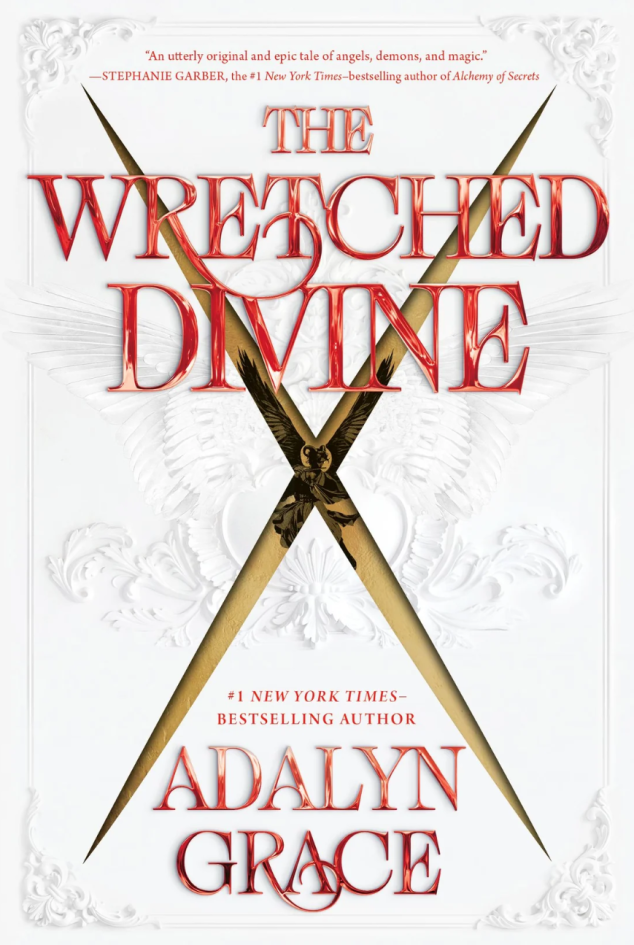
Aurelie has spent her life trusting what she was taught about angels, demons, and morality. Knowing Yuriel and Severin forces her to examine how much of that worldview she has ever truly questioned.
Aurelie Chantelune enters The Wretched Divine with a remarkably complete explanation for how her world works. Angels belong on one side, demons on the other. The Divine Scriptures give those divisions the weight of sacred truth, while Aurelie’s upbringing as a knight teaches her how to act on them. She has personal reasons for accepting that worldview, too. Demons ravaged her kingdom and destroyed her family, and she has spent her life preparing to fight them. What makes Adalyn Grace’s novel interesting to me is how steadily that certainty becomes harder to live inside once Yuriel and Severin stop being categories and become people Aurelie actually knows. The central question behind The Wretched Divine beliefs is ultimately quite simple: how much of what Aurelie considers morally obvious has she ever had reason to examine for herself?
The Divine Scriptures matter because they give Aurelie more than rules. They supply the vocabulary through which she understands good and evil. One passage presented with the book declares that demons contain no good and links them inherently with corruption and ruin. If that premise is accepted as truth, killing demons requires very little additional moral debate. Aurelie has also grown up in a kingdom where the threat is painfully tangible, so her beliefs do not feel like abstract doctrine imposed upon an otherwise peaceful life. They appear to explain what she has witnessed. That distinction made the theme much more convincing for me. Her inherited beliefs have been reinforced by grief, duty, and a war that seems to provide evidence for everything she was taught. Questioning the Divine Scriptures therefore means disturbing the structure Aurelie has used to make sense of her own suffering.
Yuriel complicates that structure from within. Aurelie expects to inherit a soulbond with him through the Chantelune bloodline, and his angelic power is considered crucial to the kingdom’s survival. Severin creates a very different problem when circumstances push Aurelie into forming a second bond with a demon who claims he can help end the war. I like the symmetry of that setup because Aurelie becomes personally tied to beings positioned on opposite sides of the moral system she inherited. Yuriel gives her access to the supposedly righteous side as something more intimate than an ideal, while Severin forces her into sustained contact with someone she has every cultural and personal reason to distrust. The angels-versus-demons conflict can no longer remain comfortably theoretical when Aurelie’s understanding of both sides depends increasingly on what she observes for herself.
Severin is especially important to the Aurelie character arc because trusting him requires her to confront the gap between doctrine and experience. He is still a demon, and the novel does not need Aurelie to forget everything that has happened to her for that tension to work. The more disruptive discovery is that a demon can be someone with whom she communicates, cooperates, and develops a meaningful relationship. Aurelie, Yuriel, and Severin eventually have to work together in pursuit of a cure that could turn demons back into humans, while their growing knowledge of one another causes Aurelie to question both the war and her own role in it. That is where The Wretched Divine morality becomes most interesting. A belief such as “demons cannot be trusted” sounds uncomplicated when demons exist at a distance. It becomes much harder to preserve unchanged when Aurelie has to reconcile it with an actual individual standing in front of her.
I also appreciate that Aurelie’s doubts are tied to the unsettling discovery that the boundary between human and monster is less stable than she was taught to assume. People she loves begin turning into the very creatures she has sworn to destroy, which sends her looking for help where she would once have considered it unthinkable. That development puts real pressure on the moral categories of the Divine Scriptures. If someone can cross from one category into another, the label “demon” suddenly carries questions that a simple good-versus-evil framework cannot answer. The prejudice at the center of the war becomes harder for Aurelie to separate from the language used to justify it. For me, this is one of the more effective ideas in The Wretched Divine: inherited beliefs can feel self-evident partly because the people around you use the same definitions, repeat the same explanations, and organize their lives around the same assumptions.
That does not mean Aurelie simply discovers that everything she was taught was false. I would have found that considerably less interesting. Her suspicion of demons has roots in genuine loss, while her allegiance to the angels is intertwined with family legacy, military service, and the survival of her kingdom. What changes is her willingness to treat those inherited conclusions as conclusions rather than unquestionable facts. The deeper her relationships with Yuriel and Severin become, the more explicitly the novel places her between the opposing sides and makes her reconsider the war itself. That distinction is what gives The Wretched Divine themes some substance beyond the familiar fantasy device of discovering that the supposed enemy has been misunderstood. Aurelie begins having to decide which parts of her worldview still survive contact with experience. That is a much messier process than simply swapping one allegiance for another.
That is the part of The Wretched Divine by Adalyn Grace that stayed with me most. Its angels and demons provide the fantasy machinery, yet Aurelie’s more interesting struggle concerns the authority she has granted ideas she inherited before she was old enough to test them. Personal experience does not automatically make her wiser, and questioning authority does not instantly provide better answers. It does, however, force her to take greater responsibility for what she believes. For readers looking for The Wretched Divine themes explained, I think that tension is central to understanding Aurelie: her character arc pushes her from living inside a moral framework supplied by other people toward examining why she accepts its categories in the first place. That makes the novel worth discussing beyond its war, romance, and supernatural mythology. There is something uncomfortable and recognizable in watching certainty weaken once the people you were taught to fear become too complicated to fit the story you were given.
Pros:
- Gives Aurelie’s character arc more depth than a straightforward good-versus-evil conflict.
- Uses Yuriel and Severin to challenge her inherited beliefs about angels and demons in a personal way.
- Raises interesting questions about indoctrination, prejudice, morality, and questioning authority.
- Makes the fantasy war more compelling by complicating the moral categories behind it.
- Connects Aurelie’s changing beliefs to her relationships and firsthand experiences.
Cons:
- The angels-versus-demons setup can initially feel familiar for fantasy readers.
- Readers wanting clear moral divisions may find Aurelie’s growing uncertainty frustrating.
- The thematic questions can be more interesting than some of the broader fantasy conflict surrounding them.
Bottom Line:
What I like most about The Wretched Divine is the way Aurelie gradually realizes that believing something her entire life does not mean she has examined why she believes it. Her relationships with Yuriel and Severin make the novel’s angels-and-demons conflict feel personal, turning inherited ideas about good and evil into a much more interesting question about forming your own moral judgment.
Tags:
The Wretched Divine beliefs, The Wretched Divine themes explained, Aurelie The Wretched Divine, The Wretched Divine, Adalyn Grace, The Wretched Divine analysis, The Wretched Divine religious themes, Books to Read