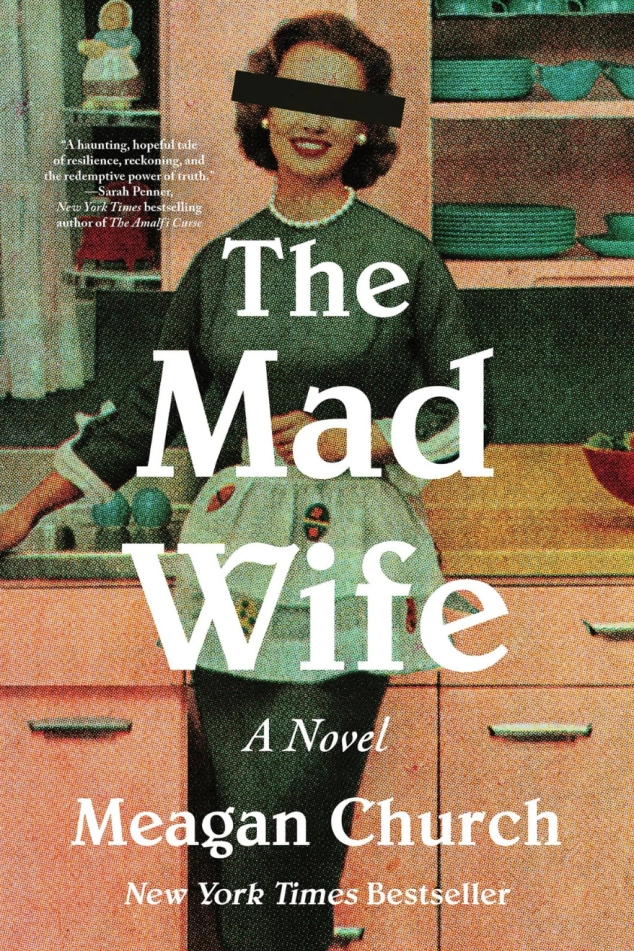
Meagan Church’s novel shows how marriage, motherhood, and domestic respectability can become demanding performances. The Mad Wife reveals the personal cost of always appearing composed.
The perfect wife is expected to make effort look invisible. The meals appear on time, the children remain presentable, the marriage looks secure, and any frustration is softened before it makes another person uncomfortable. The Mad Wife by Meagan Church understands how exhausting that performance can become when a woman’s value depends on maintaining it. This is why the novel deserves to be read: it takes the familiar image of domestic perfection and reveals how easily it can conceal grief, resentment, fear, and a disappearing sense of self.
Set in 1950s suburbia, The Mad Wife follows Lulu Mayfield, who has spent years shaping herself into the ideal housewife. After the birth of her second child, the life she has carefully arranged begins to feel less stable. Her attention turns toward a new neighbour named Bitsy, whose polished manner and constant smile appear to represent everything Lulu has been taught to admire. As Lulu becomes increasingly preoccupied with the woman across the way, questions arise about Bitsy’s seemingly flawless life and Lulu’s own state of mind.
What stayed with me most was the novel’s treatment of marriage as something performed for an audience. Lulu’s home is a private space filled with fatigue and memories she has tried to suppress, yet it also functions as a public display of her competence. Every household success becomes evidence that she is doing womanhood correctly. A tidy room or admired gelatin salad carries more weight than it should because these details reassure the neighbourhood that her marriage is orderly. Church makes domestic expectations in marriage feel quietly restrictive by showing how ordinary tasks can become tests of character.
Bitsy sharpens this tension because she embodies socially approved femininity in its most convincing form. She seems graceful, agreeable, and composed, which makes Lulu’s own exhaustion feel like a personal failure. My reading of Bitsy is that she represents both an ideal and a warning. She shows how approval can become a form of control when women are rewarded for being pleasant enough, useful enough, and undemanding enough. Church has described Bitsy as a figure who reflects the cost of complete compliance, an idea that gives their relationship much of its unsettling force.
Motherhood carries a similar pressure in The Mad Wife. Lulu is expected to care for her children while remaining emotionally reassuring to everyone around her. Her pain must stay manageable, preferably hidden. This creates a sharp portrayal of motherhood and social pressure, especially in a culture where distress can be treated as evidence that a woman is failing at the role she wanted. Church grounds the psychological suspense in Lulu’s uncertainty about her own perceptions, allowing the reader to feel how frightening it is when a woman’s suffering is dismissed before anyone seriously considers what caused it.
The novel feels quietly unsettling because its threat grows through repetition, silence, and the erosion of trust. Church does not need to make every domestic moment dramatic. The routines themselves begin to feel oppressive because Lulu has so little room to express an unacceptable emotion without risking judgment. The fear comes from watching her perform wellness while her private experience tells a different story. Church has connected the novel’s origins to the history of women’s mental health and to the question of how easily female pain can be misunderstood or silenced.
Although the setting belongs to the postwar period, the perfect-wife image remains recognizable because the basic demand has survived: women are still encouraged to make difficult domestic lives look effortless. Readers interested in historical fiction about women will find that The Mad Wife uses its period setting to examine enduring questions about femininity and identity. I would recommend this novel to readers who enjoy women’s historical fiction, psychological suspense, books about marriage and motherhood, and feminist historical fiction with a strong domestic focus. Its central question lingers because the ideal wife has never been defined solely by what she does. She is judged by how convincingly she smiles while doing it.
Pros:
- Sharp examination of the perfect-wife and perfect-mother ideals
- Strong themes of marriage, motherhood, identity, and emotional labour
- Quietly unsettling domestic atmosphere
- Thoughtful use of its 1950s setting
- Appeals to readers of feminist historical fiction and psychological suspense
Cons:
- The restrained pace may feel slow to readers seeking constant action
- Its domestic focus can feel emotionally heavy
- Readers who prefer plot-driven historical fiction may find the thematic emphasis less satisfying
Bottom Line:
The Mad Wife is a compelling choice for readers interested in women’s historical fiction and books about marriage, motherhood, and social pressure. Its lasting strength lies in showing how domestic perfection can become a convincing performance that gradually erases the woman expected to maintain it.
Tags:
The Mad Wife, Meagan Church, The Mad Wife book review, The Mad Wife novel, historical fiction about women, feminist historical fiction, women’s historical fiction, books about marriage and motherhood, novels about the perfect wife