Compare strength Pilates vs weight training, explore beginner tips, and find a practical, balanced four-day workout split. Do you like this personality?
When I see a reformer class advertised as “strength Pilates,” part of me wonders how a sliding carriage, some springs, and a few straps are supposed to compete with a squat rack. It’s a fair question, especially if your usual workout involves dumbbells and a playlist loud enough to drown out your own complaints. So, can reformer Pilates build real strength? Yes, reformer Pilates can improve muscular strength and endurance, particularly for beginners or people returning to exercise. It also develops the kind of movement control that makes challenging exercises feel more manageable. However, in the Pilates vs weight training debate, conventional progressive resistance training still has the clearer advantage for maximizing muscle growth and absolute strength. I'm increasingly convinced that both deserve attention, especially if you want a workout routine that develops more than your ability to lift something heavy.
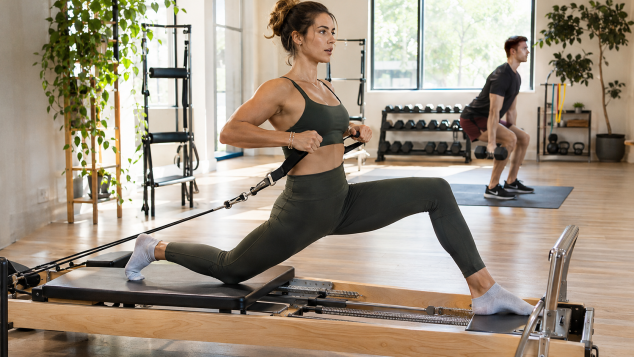
The overlap between strength Pilates and weightlifting is bigger than some gym regulars might expect. A reformer uses springs to create resistance as you push or pull a moving carriage, while straps and body positioning change the challenge. Slow repetitions can make your legs shake, and stabilizing your pelvis while pulling the straps demands attention that a supported machine row might not. Still, a shaking muscle is not automatically a growing muscle. With free weights or gym machines, external loads are easier to measure and increase in small steps. Reformer resistance varies with the spring setup, position, and movement angle, so comparing spring colours to kilograms misses the point. One of the most interesting reformer Pilates benefits for strength is learning to produce force while maintaining control, particularly during movements that challenge balance or coordination.
Does Pilates build muscle? It can, provided the exercise offers enough resistance, the working muscles are challenged sufficiently, and the difficulty increases as you adapt. That last part, progressive overload, matters in both settings. Muscular endurance involves sustaining repeated contractions, while maximal strength means producing high force. Hypertrophy refers to an increase in muscle size, which requires a sufficient training stimulus over time. Reformer Pilates strength training often emphasizes sustained effort and precise movement, although demanding exercises can stimulate strength gains too. Research specifically examining Pilates for muscle growth remains more limited than the evidence supporting conventional resistance training. The American College of Sports Medicine's resistance training research review supports heavier loading for maximizing strength. For someone already lifting substantial weights, a typical reformer session is unlikely to replace the muscle-building stimulus of progressively loaded squats or presses.
There are reformer exercises I’d happily add to a serious training week. Reformer footwork, which involves pressing the carriage away with your feet, trains the quadriceps and glutes while encouraging controlled knee and hip alignment. Resisted lunges challenge the glutes and thighs one leg at a time, with balance adding a useful complication. Seated or kneeling rows using straps target the upper back and arms while asking the trunk to stay steady. Then there are controlled core exercises, such as supine arm pulls with the legs held in tabletop, which challenge the abdominals to resist unwanted movement. I particularly like the idea of using single-leg reformer exercises to identify differences in control between sides. A movement that looks almost ridiculously simple can become surprisingly demanding when you remove momentum and concentrate on positioning.
My preferred Pilates and weight training workout split would use four training days without making every day a test of willpower. Monday is full-body weight training, prioritizing squats and bench presses, followed by rows and loaded carries. Tuesday is a moderate reformer session focused on footwork and upper-body pulling, with plenty of trunk control. Wednesday is recovery, perhaps a walk. Thursday returns to weights for Romanian deadlifts, split squats, overhead presses, and a vertical pull such as pulldowns. Friday is another recovery day. Saturday is reformer Pilates, emphasizing single-leg work and hip stability alongside controlled core exercises, with Sunday free. On weights days, I'd generally aim for two or three working sets of six to ten repetitions per lift, using loads that remain challenging without compromising technique. This combination gives major muscle groups regular resistance training while leaving space for recovery.
If you're wondering whether reformer Pilates is good for beginners, I think it can be an excellent starting point with a qualified instructor and sensible spring choices. Begin with 30 to 45 minutes, choosing resistance that allows roughly 8 to 12 controlled repetitions for challenging movements, or 10 to 15 for lighter patterns, for one or two sets initially. Exhale during the demanding phase, inhale on the return, and avoid holding your breath through every shaky second. Keep the carriage moving smoothly instead of letting the springs yank it home. Good instruction matters because reformer settings can change how challenging an exercise feels, and more springs do not always mean a harder movement. As your technique improves, gradually add resistance where appropriate or increase the difficulty of the exercise. Consistency matters more than trying to survive the toughest class on the schedule during your first week.
Can Pilates replace weights? For someone seeking general fitness, better movement confidence, or a manageable introduction to resistance exercise, reformer sessions may provide enough challenge for their current goals. If building substantially bigger muscles or improving a heavy squat is the priority, I'd keep traditional lifting at the centre of the plan. Ultimately, the best Pilates and strength training routine depends on what you want your body to do, and there's no prize for being loyal to one piece of equipment. Personally, I find the appeal of strength Pilates increasingly convincing because it encourages a level of body awareness that can get overlooked when the only goal is adding another plate. My verdict is simple: keep the weights for progressive loading, and give the reformer a place in the week. Improving how you move while continuing to build strength sounds like a worthwhile combination to me.
Pros:
- Builds muscular strength and endurance, especially for beginners.
- Improves core stability, balance, and body control.
- Strengthens muscles through controlled, resistance-based movements.
- Encourages better movement mechanics and muscle awareness.
- Provides adjustable resistance using reformer springs.
- Complements traditional weightlifting by targeting stability and coordination.
- Offers a challenging workout without requiring heavy weights.
Cons:
- Less effective than progressive weight training for maximizing muscle growth.
- Limited resistance may eventually challenge experienced lifters less.
- Progressive overload can be harder to measure than with free weights.
- Reformer classes and equipment can be expensive.
- Proper technique often requires qualified instruction.
- May provide insufficient resistance for significant improvements in maximal strength.
- Results depend heavily on exercise selection, intensity, and consistency.
Bottom Line:
Strength Pilates deserves a place in a well-rounded fitness routine, but I wouldn't replace traditional weight training with it if building serious muscle is the goal. Reformer workouts offer genuine strength benefits, particularly for improving core stability, muscular endurance, and controlled movement. My preferred approach is combining two weekly weightlifting sessions with two reformer Pilates workouts. That gives you the measurable strength progression of lifting alongside the movement-focused benefits of Pilates. For me, that's a combination worth making room for.
Tags:
pilates vs weight training, strength pilates, reformer pilates, reformer pilates strength training, does pilates build muscle, can pilates replace weights, strength pilates vs weightlifting, pilates for muscle growth