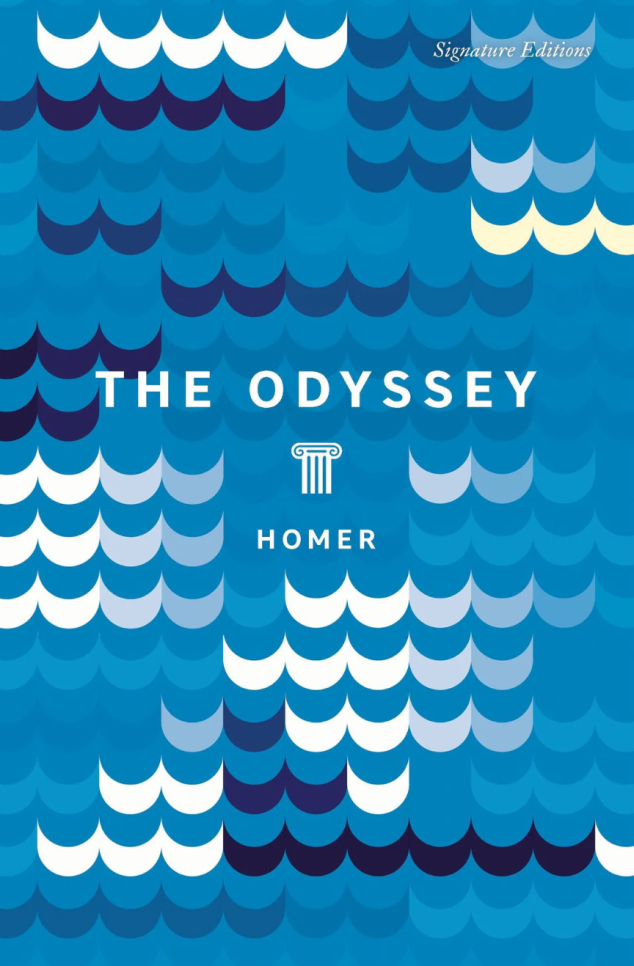
Reading The Odyssey first gives you a deeper understanding of Odysseus, Penelope, Telemachus, and the forces shaping their choices.
Most people already know a few images from The Odyssey: a one-eyed giant, a dangerous song drifting across the sea, and a sailor struggling to reach home. Reading the complete story reveals how much meaning surrounds those famous scenes. The Odyssey by Homer is worth reading before a movie adaptation because it gives you the character motives, family tensions, divine rivalries, and recurring symbols that a film may shorten or interpret differently. The Signature Classics edition identifies Samuel Butler as its translator, offering readers a traditional English version of this foundational epic.
Odysseus becomes far more interesting on the page than the straightforward adventure hero people may expect. He is intelligent, persuasive, resilient, proud, and frequently responsible for making his own problems worse. His cleverness helps him survive the Cyclops and several later dangers, while his appetite for recognition exposes the vanity beneath his heroic reputation. Reading The Odyssey book before watching the movie makes it easier to see why his decisions matter. An adaptation can show what he does; Homer gives readers enough context to consider what those choices reveal about him.
The time spent away from Odysseus is equally valuable. Penelope’s situation in Ithaca carries its own suspense as unwanted suitors consume the household’s wealth and pressure her to abandon hope of her husband’s return. Her patience involves strategy and careful judgment, giving her genuine agency within the limits of her world. Telemachus also develops from an uncertain young man living under his father’s reputation into someone prepared to defend his family and home. Understanding Odysseus and Penelope, along with Telemachus’s growth, can make their relationships feel much richer when a screen adaptation compresses the years of separation.
The gods add another layer that movies sometimes simplify to keep the story moving. Athena supports Odysseus and encourages Telemachus, while Poseidon’s anger turns the sea into an extension of personal conflict. Divine help rarely removes human responsibility. The gods have preferences, grudges, and competing interests, which makes the world feel politically unstable as well as supernatural. The Cyclops, Circe, the Sirens, Scylla, and Charybdis also work as more than impressive obstacles. Each encounter tests a different weakness or survival instinct, from curiosity and pride to appetite, self-control, and fear.
That deeper structure changes the meaning of the voyage. Odysseus is travelling toward a physical destination, yet Ithaca also represents identity, belonging, responsibility, and the life he risks losing through delay. Temptation appears in several forms, including comfort, admiration, immortality, and the chance to forget the obligations waiting at home. This is one reason The Odyssey remains relevant to modern readers. Its world contains monsters and divine intervention, while its emotional centre is recognizable to anyone who has wondered whether a long absence can change a person beyond recognition.
The Samuel Butler translation deserves a little preparation. First published in 1900, it renders Homer’s epic in English prose, and some of its phrasing carries the formal tone of its period. The prose format can help new readers follow the story’s movement without also having to adjust to an unfamiliar verse pattern. I found that the traditional language became easier after the opening sections, especially once the shifting perspectives and nested stories began to connect. The Odyssey Samuel Butler translation may lack the contemporary rhythm of newer versions, though the Signature Classics presentation still provides a practical entry point for readers who want the original narrative in a complete, approachable volume.
For anyone wondering whether they should read The Odyssey before the movie, my answer is yes. Knowing the book will not spoil the pleasure of seeing its seas, creatures, and confrontations brought to the screen. It gives you a clearer view of what the filmmakers emphasize, remove, rearrange, or reinterpret. Among classic books worth reading, this one earns its place because the adventure remains exciting and the homecoming carries real emotional weight. I would read The Odyssey book before watching the movie, then treat the adaptation as another storyteller’s journey through the same ancient waters.
Pros:
- Adds valuable context before watching a movie adaptation
- Makes Odysseus, Penelope, and Telemachus feel more layered
- Gives greater meaning to the gods, monsters, and symbolic obstacles
- Explores timeless themes of loyalty, pride, temptation, family, and homecoming
- Samuel Butler’s prose translation can be easier to follow than verse
Cons:
- The traditional language may feel dated at first
- Its nonlinear storytelling requires close attention
- Some sections move more slowly than modern adventure novels
- Ancient customs and social values may feel unfamiliar to contemporary readers
Bottom Line:
The Odyssey is worth reading before watching a movie adaptation because it reveals the motives, relationships, and symbolism that a film may condense. Samuel Butler’s translation takes some adjustment, though the story’s emotional power and complicated characters make the effort rewarding.
Tags:
The Odyssey by Homer, The Odyssey book, Read The Odyssey before the movie, The Odyssey Samuel Butler translation, The Odyssey movie adaptation, The Odyssey book before watching the movie, The Odyssey book review, Odysseus and Penelope, Greek mythology