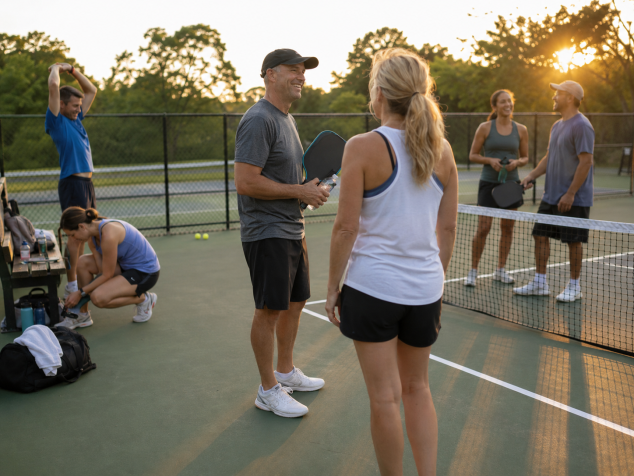
Social sports are becoming a favorite healthy habit for adults because they combine regular movement with real-life connection.
Social sports for adults are becoming a healthy habit because they make movement feel less like another task and more like something worth showing up for. A casual tennis match after work, a beginner pickleball night, a low-pressure soccer league, or a swimming group can turn physical activity into a standing plan with real people. That is what makes this kind of consistent exercise routine feel different from the solo workouts I have abandoned after two motivated weeks.
What I like most about recreational sports is the built-in accountability. When I am meeting someone at a court, a field, or a pool, I am much less likely to talk myself out of going. It is easier to keep a swimsuit in a gym bag when I know a friend is already planning to swim laps. It is easier to lace up for casual soccer when the team needs enough players. The commitment stays light, but it still gives me the little push I need.
The social part matters more than I expected. Adult life can get strangely scheduled and separate, even when everyone is technically busy doing fine. Social sports create an easy reason to see people without making dinner reservations or forcing a big plan. You can chat between pickleball games, laugh through a bad serve, or cool down after tennis without feeling like every hangout has to be a major event. An active social life feels more natural when the activity is already built in.
There is also something satisfying about learning a skill in a low-pressure setting. Adult sports leagues are often full of people who are rusty, new, or simply there for fun, which makes them less intimidating than they sound. Recreational tennis teaches timing and patience. Pickleball rewards quick reactions and clever placement. Soccer brings back that scrappy team energy many of us forgot we missed. Swimming gives you a quieter kind of focus, especially when the day has been loud.
I also understand why social sports are getting more attention as healthy habits for adults. Health.com recently pointed to social sports as useful because they combine movement, mental engagement, and social connection, which feels accurate to my own experience. A game asks you to pay attention, react, coordinate, and communicate. It can support mood, confidence, focus, and stress relief in a practical way, without making the whole thing feel like a wellness assignment.
The best part is that social sports can be scaled to your actual life. You do not need to become a serious athlete to benefit from regular physical activity. A relaxed weekend match counts. A once-a-week swimming group counts. A beginner-friendly adult sports league counts. So does saying yes to pickleball when you only know half the rules. The habit works because it leaves room for imperfect schedules, mixed fitness levels, and days when showing up is the win.
That is why social sports have become one of my favorite healthy habits for adults. They make exercise feel more social, more playful, and more sustainable. I still appreciate solo workouts, but I am much more consistent when movement is tied to people I like and a plan I do not want to cancel. For anyone trying to build a consistent exercise routine without making fitness feel like a second job, recreational sports might be the most enjoyable place to start.
Pros:
- Makes exercise feel more social and less like a chore.
- Helps adults stay consistent because there is built-in accountability.
- Supports regular physical activity through fun, repeatable movement.
- Encourages connection, teamwork, and an active social life.
- Works for different fitness levels, especially with beginner-friendly adult sports leagues.
- Offers variety through pickleball, tennis, soccer, swimming groups, and casual recreational sports.
- Builds confidence and coordination over time without needing an intense gym routine.
Cons:
- Scheduling can be tricky when games or meetups depend on other people.
- Some leagues, court bookings, or equipment can add extra cost.
- Beginners may feel nervous at first, especially in competitive settings.
- Weather can interfere with outdoor sports like tennis, pickleball, or soccer.
- It may take time to find the right group, pace, or skill level.
Bottom Line:
Social sports are one of the easiest healthy habits for adults to stick with because they combine movement, fun, and real connection. For anyone who struggles with solo workouts, recreational sports can turn a consistent exercise routine into something that feels less forced and more enjoyable.
Tags:
social sports, healthy habits, social sports for adults, adult sports leagues, recreational sports, recreational tennis, pickleball, tennis, soccer, swimming, active lifestyle,