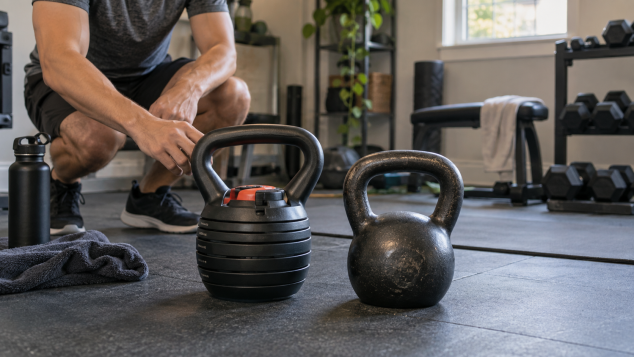
Adjustable kettlebells save space and offer multiple weight options in one compact design, while regular kettlebells provide consistent balance and faster transitions between exercises.
The adjustable kettlebell vs regular kettlebell decision gets much more interesting once you picture the equipment sitting in an actual home rather than lined up neatly in a commercial gym. A traditional fixed-weight kettlebell is wonderfully uncomplicated: pick it up, train, put it down. An adjustable kettlebell squeezes several resistance levels into one piece of home gym equipment, usually by letting you add, remove, or select internal weight plates. Some models use a dial or selector, while others require opening the kettlebell and manually changing plates. For a compact home gym, that space saving is hard for me to ignore. One adjustable weight can replace a small row of kettlebells that would otherwise take up floor space, which makes particular sense in an apartment, spare bedroom, or workout corner where every square foot has another job.
Regular kettlebells still have the better training feel in my experience with this style of strength equipment. A good fixed-weight kettlebell has a simple body, predictable balance, and a handle that feels the same every time you grab it. There is no adjustment mechanism to think about and nothing to change before the next exercise. That matters more than it sounds. If I am moving from goblet squats to rows during a circuit, grabbing a second fixed-weight kettlebell takes seconds. Stopping to unlock an adjustable kettlebell, change plates, secure everything again, and then check that it feels right can interrupt the rhythm of a workout. Fixed kettlebells are also appealing for durability because their uncomplicated construction leaves fewer moving components to wear out. For frequent kettlebell training, especially sessions built around fast exercise changes, that immediate readiness is a real advantage.
The case for an adjustable kettlebell becomes stronger when you consider how many weights one person may eventually need. Beginners rarely use exactly the same resistance for every kettlebell exercise. Someone might need a relatively light kettlebell for learning an overhead press or another movement where control is the priority, then comfortably use more weight for kettlebell deadlifts, goblet squats, or eventually swings. There is no single correct beginner kettlebell size because appropriate resistance depends on your current strength, technique, the exercise, and how many repetitions you are performing. A useful adjustable range for a new home gym might begin somewhere around 8 to 12 kg and extend into the 20 kg range or beyond, provided the available increments match the person's needs. Someone who is completely new to resistance training may need less for certain movements, while an experienced lifter beginning kettlebell training may need considerably more. This is where adjustable kettlebells can be good for beginners: you can experiment with several resistance levels without guessing which single fixed-weight kettlebell will cover everything.
Handling becomes especially important once kettlebell swings enter the picture. Swings are ballistic exercises, meaning the kettlebell moves with speed and momentum rather than being lifted slowly through the entire repetition. I would pay close attention to an adjustable kettlebell's locking system, shape, handle clearance, and balance before using one regularly for swings. Adjustment mechanisms vary by model, and the plates should lock securely enough that the kettlebell feels solid during dynamic movement. Some adjustable designs keep their external dimensions fairly consistent as the weight changes, while others can feel different depending on how much weight is installed. A traditional kettlebell gives me more confidence here simply because its balance is predictable and there is nothing inside to adjust. Beginners should also learn a proper hip hinge before trying to make swings faster or heavier. I would become comfortable with kettlebell deadlifts first, then practice the hinge pattern until the hips are driving the movement rather than turning the exercise into a squat or an arm lift.
A beginner kettlebell workout at home can be surprisingly complete with either design. I would train three nonconsecutive days per week at first, leaving recovery time between sessions. Day 1 could use goblet squats, one-arm rows, floor presses, and loaded carries. Two or three sets of roughly 6 to 12 controlled repetitions per exercise works well as a starting framework, while carries can be performed for a manageable distance or 20 to 40 seconds. Day 2 could include kettlebell deadlifts, overhead presses, supported split squats, and simple core work such as a suitcase hold. Day 3 could introduce kettlebell swings once the hip hinge is technically sound, followed by reverse lunges, another row or press, and loaded carries. For swings, I would keep the early sets short, perhaps 5 to 10 crisp repetitions, because technique usually deteriorates before cardiovascular effort becomes the limiting factor. Resting around 60 to 120 seconds between ordinary strength sets is reasonable, with more rest when needed to maintain good movement quality. Squats, hinges, pushes, pulls, and carries also give the routine enough variety that a beginner is practicing useful full-body movement patterns rather than collecting random kettlebell exercises.
Progressive overload is where adjustable weight becomes especially useful. If a kettlebell feels easy for every set and the repetitions remain controlled, an adjustable model may let you increase resistance gradually instead of making a large jump to the next fixed weight. The size of those jumps depends entirely on the adjustment system, so I would check the actual available increments before buying. Progress does not require adding weight every workout, either. A beginner can improve by adding a repetition, performing another set, using cleaner technique, or controlling the lowering portion of an exercise more deliberately. Several fixed-weight kettlebells make resistance changes much faster during the workout, though. If I want a heavier bell for deadlifts, a lighter one for presses, and another weight for lunges, having all three sitting beside me is incredibly convenient. With an adjustable kettlebell, I would accept a little setup time in exchange for needing only one compact piece of strength equipment.
So, which kettlebell would I actually want at home? In a small workout area, I would choose an adjustable kettlebell with a comfortable handle, useful weight increments, and a locking system that feels completely secure. Replacing several bulky weights with one kettlebell is simply more practical for the way most compact home gyms have to function, and the ability to increase resistance gradually gives it excellent long-term value. If I had a dedicated gym room and kettlebells were a major part of my training, I would build a small collection of regular kettlebells instead. I prefer their consistent balance and the convenience of grabbing another weight immediately when the next exercise starts. For someone asking whether an adjustable kettlebell is worth it, I think the answer depends largely on space and training style. Occasional home exercisers and people who need several resistance levels from a tiny footprint have a strong reason to go adjustable. Someone doing frequent swings, circuits, or serious kettlebell-focused strength training may appreciate fixed-weight kettlebells enough to give up the extra floor space.
Pros:
- Saves considerable floor space in a small home gym
- Replaces several fixed-weight kettlebells with one piece of equipment
- Makes progressive overload easier when the adjustment increments are practical
- Useful for beginners who need different weights for presses, squats, deadlifts, and other exercises
- Can offer better overall value than buying several separate kettlebells
Cons:
- Weight changes can interrupt the flow of circuits or supersets
- Some models feel less balanced than a traditional fixed-weight kettlebell
- Adjustment mechanisms add moving parts that may wear over time
- Handle shape and clearance can vary more between designs
- Fixed kettlebells are usually quicker and more predictable for frequent swings and fast-paced training
Bottom Line:
For my own home gym, I would choose an adjustable kettlebell if space were limited because getting several useful resistance levels from one compact piece of equipment is hard to beat. If I trained with kettlebells several times a week and had enough room, I would rather own a few fixed-weight kettlebells for their consistent feel, durability, and grab-and-go convenience.
Tags:
adjustable kettlebell vs regular kettlebell, adjustable kettlebell worth it, best kettlebell for home gym, kettlebell for home gym, what size kettlebell to buy, adjustable kettlebell for beginners, fixed weight, adjustable kettlebell