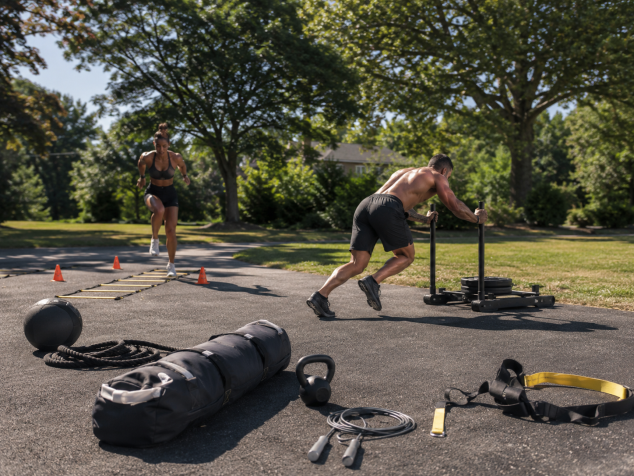
Portable workout gear like sandbags, jump ropes, cones, agility ladders, and sleds can turn a basic backyard, driveway, or park workout into something more athletic and interesting.
Summer outdoor training gets a lot easier to stick with when it feels less like dragging a gym routine onto the lawn and more like building a workout around the space you actually have. I’ve tried the basic park workout routine with push-ups, squats, and a few laps around the field, and it works for a while. The problem is that it can get boring fast. What changed things for me was adding simple outdoor workout equipment that made each session feel more like practice than punishment: a sandbag, jump rope, agility ladder, cones, and, when space allows, a resistance sled.
The best portable workout gear for summer is the kind that does more than one job. A sandbag can be carried, shouldered, squatted, pressed, dragged, or loaded over a bench. A jump rope turns a small patch of driveway into a conditioning session. Cones make shuttle runs, sprint starts, and change-of-direction drills feel organized instead of random. An agility ladder adds footwork and coordination without needing much room. A resistance sled is the least casual piece of the group, but for driveway workouts or turf-friendly park workouts, it is one of the most useful tools for building legs, lungs, and grit without complicated technique.
That is the real appeal of functional fitness equipment outdoors: it makes training feel more athletic. Indoor workouts can become predictable because the environment stays the same. Outside, you can use open space, short distances, hills, grass, pavement, and shade to your advantage. Sandbag training builds awkward, real-world strength because the weight shifts. Jump rope workouts improve rhythm and conditioning. Agility ladder drills help with quick feet and body control. Resistance sled workouts let you push hard without the same pounding as repeated sprints. Together, this kind of backyard fitness setup makes summer outdoor training more engaging because every piece of gear gives you a different problem to solve.
For beginners, I’d structure the week around four main sessions instead of trying to train hard every day. Day one can be a strength-focused sandbag session: sandbag squats, bear-hug carries, shoulder-to-shoulder presses, and loaded walks. Day two can be conditioning with a jump rope and cones: easy rope intervals, short shuttle runs, and walk-back recovery. Day three can focus on agility and footwork using an agility ladder, cones, and light bodyweight movements like lunges or push-ups. Day four can be a sled or carry day, using resistance sled pushes, backward drags, farmer-style carries, and a few short core finishers. That gives beginners a clear outdoor workout split without turning every session into the same sweaty grind.
A realistic beginner outdoor workout might look like this: Monday for sandbag strength, Wednesday for jump rope conditioning, Friday for agility ladder drills, and Saturday for sled work or loaded carries. On the sandbag day, use a lighter bag than your ego wants and aim for clean movement over max effort. On the conditioning day, jump rope for 30 seconds, rest for 30 to 60 seconds, then mix in cone shuttles at a pace that feels controlled. On the agility day, keep the ladder drills crisp and short because sloppy footwork defeats the point. On the sled day, start with short pushes of 10 to 20 yards and take full rests. Beginner outdoor workouts should leave you feeling trained, not cooked.
The biggest mistake people make with summer outdoor training is treating heat like a toughness test. It is fine to sweat, but it is also smart to train early, use shade, keep water nearby, and reduce intensity when the sun is heavy. Another mistake is buying too much gear before learning what you actually enjoy. A jump rope, cones, and a basic sandbag are enough to make park workouts, driveway workouts, and backyard fitness sessions more interesting right away. Add an agility ladder if you like athletic movement, and consider a sled only if you have the right surface and enough space.
What I like most about this setup is that it gives outdoor workouts a sense of purpose. You are not just doing random exercises because it is nice outside. You are building strength with sandbag training, improving conditioning with jump rope workouts, practicing movement with agility ladder drills, and adding lower-body power with resistance sled workouts. For anyone wondering what equipment is best for outdoor workouts, I’d start with portable gear that is compact, durable, and easy to combine. The more flexible the gear, the more likely you are to use it all summer.
Pros:
- Makes summer outdoor training feel less repetitive than basic bodyweight workouts.
- Portable workout gear works well for parks, driveways, backyards, and open fields.
- Sandbags are great for practical strength, carries, squats, presses, and full-body conditioning.
- Jump ropes are affordable, compact, and excellent for quick cardio sessions.
- Agility ladders and cones make workouts feel more athletic with footwork, shuttle runs, and change-of-direction drills.
- Resistance sleds add serious lower-body strength and conditioning without needing a full gym setup.
- Easy to scale for beginners by using lighter loads, shorter intervals, and longer rest periods.
- Helps combine strength, conditioning, agility, and movement variety in one weekly routine.
Cons:
- Outdoor training depends on weather, space, and surface quality.
- Summer heat can make workouts harder to recover from if pacing is poor.
- Some gear, especially sleds, needs the right driveway, turf, grass, or pavement setup.
- Sandbags and sleds can be awkward to store compared with smaller gear.
- Beginners may overdo conditioning drills if they treat every workout like a max-effort challenge.
- Agility ladders can feel gimmicky if they are used without focus or proper movement control.
- Portable gear still requires planning, otherwise workouts can become random.
Bottom Line:
Portable outdoor workout equipment is worth it if you want summer training to feel more active, flexible, and interesting. A simple setup with a sandbag, jump rope, cones, and an agility ladder can turn a basic park or backyard workout into a balanced routine for strength, conditioning, and athletic movement. I’d only add a resistance sled once there is enough space and the right surface to use it properly.
Tags:
summer outdoor training, outdoor workout equipment, portable workout gear, driveway workouts, backyard fitness, park workouts, sandbag training, jump rope workouts, agility ladder drills, resistance sled workouts, beginner outdoor workouts