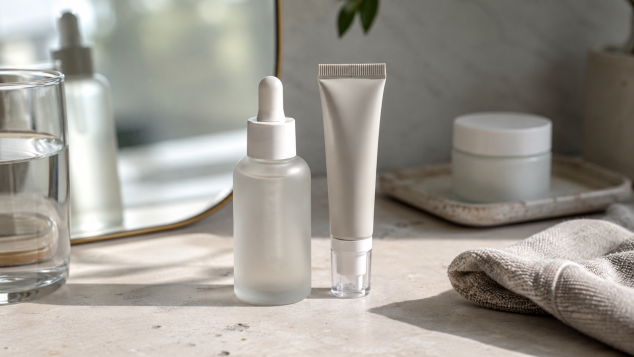
Used thoughtfully, peptides and retinol can fit into the same skincare routine to support smoother-looking, well-conditioned skin while keeping irritation in check.
Yes, you can use peptides and retinol together, including in the same evening routine if your skin tolerates both products well. I actually like this pairing because the two ingredients have very different jobs. Retinol is the more demanding part of the relationship, with good evidence behind its ability to improve the appearance of fine lines, uneven pigmentation, and rough texture over time. Peptides tend to fit more quietly into a routine, especially when they are delivered in a comfortable serum or moisturizer. That makes peptides and retinol a combination I can stick with without turning my bathroom shelf into a chemistry experiment. Dermatologists also recommend introducing retinoids gradually because dryness and irritation are common when people start too aggressively.
Peptides are short chains of amino acids, and skincare formulas use different types for different purposes. In an age-supporting routine, they are commonly used with the goal of maintaining smoother-looking skin and supporting firmness. The American Academy of Dermatology includes peptides among ingredients people may consider when addressing wrinkles and collagen loss. Still, the word "peptide" on a label does not tell you everything about how useful a product will be. A 2026 systematic review of randomized trials found encouraging results for peptide interventions, including hydration and modest wrinkle improvements, while also finding inconsistent effects for some measures such as elasticity and skin density. That is why I pay more attention to the complete formula than to how many impressive-sounding peptides are listed on the front of the bottle. Peptides are also having a noticeable beauty moment in 2026, with industry reporting pointing to renewed growth in peptide products and peptide-related consumer searches.
Retinol is where I expect more visible change, along with a higher chance that my skin will complain if I get impatient. Retinol is a vitamin A derivative that influences the way skin renews itself and can gradually improve fine lines, discoloration, and uneven skin texture. Clinical research has shown measurable improvements in photoaged skin with topical retinol, while dermatology guidance consistently warns that irritation can occur, especially during the adjustment period. This is why I think of a retinol skincare routine as something that needs supporting products around it. A gentle cleanser keeps cleansing from becoming another source of dryness, while a dependable moisturizer helps maintain comfort as skin adjusts. Peptides can fit nicely into that supporting role when the particular peptide product agrees with your skin.
So, can you use peptides with retinol on the same night? For most people, yes. There is no universal rule saying a standard cosmetic peptide product has to be separated from retinol. The order depends largely on the type of products you own. Skincare products are generally layered from thinner textures to thicker ones, so with a lightweight peptide serum and a retinol cream, I would usually cleanse, apply the peptide serum, allow it to settle, apply the retinol treatment, and finish with moisturizer. If your peptides are contained in a richer moisturizer, the order may become cleanser, retinol, then peptide moisturizer. Product directions still matter because formulations differ. That is the part of the "peptides before or after retinol" question that often gets lost online. Ingredient names alone cannot tell you the ideal application order for every formula.
My preferred peptide skincare routine is even easier to remember when I split the ingredients between morning and evening. In the morning, I use a gentle cleanser, followed by a peptide serum or peptide moisturizer, another moisturizer if my skin needs it, then a broad-spectrum SPF 30+ sunscreen. At night, the basic order is gentle cleanser, peptide serum if I am using one, retinol treatment, then a barrier-supporting moisturizer. Someone who wants fewer layers can use peptides only in the morning and reserve retinol for nighttime. That is probably the version I would recommend first to anyone already staring at six bottles and wondering how skincare became a part-time job. Daily sun protection deserves special attention here. The AAD advises nighttime retinoid use along with daytime sun protection, and Mayo Clinic recommends a broad-spectrum sunscreen with at least SPF 30 when using retinoids.
For a retinol routine for beginners, frequency matters much more to me than racing toward the strongest percentage or nightly use. The AAD recommends beginning with a less intense retinoid formula and starting around every other night before slowly increasing according to tolerance. Cleveland Clinic guidance has also recommended beginning retinol as infrequently as twice weekly when irritation is a concern. If my skin starts feeling persistently tight, flaky, sore, or unusually sensitive, I scale back instead of adding more products to fix the problem I just created. Moisturizer can also be applied before retinol when extra buffering is needed. People with especially reactive skin, eczema, rosacea, or persistent irritation should keep the routine simple and talk with a dermatologist when necessary. Retinol and other retinoids should also be avoided during pregnancy.
That is ultimately why peptide serum and retinol have earned a long-term place in my skincare routine. Retinol gives me a well-established active for fine lines, skin texture, and uneven pigmentation, while peptides give me an easy way to round out the routine without piling on another obviously irritating treatment. I also like that this combination encourages the kind of skincare I have become much more interested in: consistent use, comfortable skin, and products chosen for a clear reason. The best answer to how to layer peptides and retinol is wonderfully ordinary. Use a gentle base routine, follow the texture and directions of your actual products, introduce retinol slowly, moisturize well, and wear sunscreen every morning. That is a routine I can imagine following for years, which matters far more to me than whatever ingredient happens to be filling my feed this month.
Pros:
- Peptides and retinol can fit into the same skincare routine.
- Retinol can help improve the appearance of fine lines, uneven texture, and pigmentation over time.
- Peptide serums and moisturizers can support smoother, well-conditioned skin.
- Peptides are generally easy to use in either a morning or evening routine.
- Using peptides in the morning and retinol at night makes ingredient layering especially simple.
- Moisturizer and peptides can help keep a retinol-focused routine feeling more comfortable.
Cons:
- Retinol can cause dryness, flaking, or irritation, especially for beginners.
- Using too many products at once can make it difficult to identify what is irritating your skin.
- Layering order can vary depending on whether the peptide product is a serum or moisturizer.
- Sensitive or reactive skin may need a slower, simpler approach.
- Retinol requires consistent daytime sunscreen use.
Bottom Line:
Peptides and retinol make a practical long-term pairing for anyone interested in fine lines, skin texture, and maintaining well-conditioned skin. I like using peptides as the easy supporting step and treating retinol as the active that deserves a slower introduction. A simple routine, plenty of moisturizer, and daily SPF make this combination much easier to stick with.
Tags:
can you use peptides and retinol together, peptides and retinol, can you use peptides with retinol, how to layer peptides and retinol, peptides before or after retinol, peptide serum before retinol, peptide skincare routine, retinol skincare routine