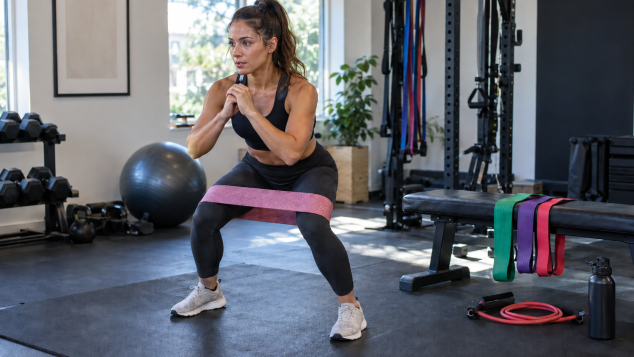
Fabric bands are a great choice for glute and lower-body training, while latex bands offer more flexibility for full-body strength, mobility, and stretching exercises.
Comparing fabric vs latex resistance bands sounds simple until you actually start training with both. They may look like interchangeable pieces of workout equipment, especially when they are sold in similar resistance levels, yet they behave quite differently once you start squatting, pulling, pressing, or stretching against them. After using both types for home workouts and as accessories to regular strength training, I have a pretty clear preference depending on the exercise. I reach for fabric loops for most glute and lower-body work because they stay put and feel better against my legs. When I want more range of motion or need a band for upper-body exercises, mobility work, or assisted movements, latex bands are much more useful. For most people deciding between resistance band types, that is the simplest way to think about the choice.
Fabric resistance bands are particularly good for glutes and lower-body activation. They are usually made from woven elastic material, creating a thicker loop that stretches less dramatically than a typical latex mini band. That shorter, firmer resistance works well for lateral band walks, banded squats, glute bridges, hip abductions, and similar exercises where the band only needs to travel a moderate distance. I especially notice the difference during lateral walks. A fabric band tends to stay where I place it above my knees instead of gradually curling into a narrow strip or sliding down my legs. It also feels more comfortable against bare skin when I am wearing shorts. That combination is why I consider fabric bands some of the best bands for glutes, particularly for anyone who finds thin rubber loops distracting during a workout. Their limitation is the same quality that makes them useful: the restricted stretch can make fabric bands awkward for exercises that require a long movement path.
Latex resistance bands give me far more exercise options. Thin latex loops, longer continuous-loop bands, and tube-style bands can stretch through a much greater range, which makes them practical resistance bands for strength training beyond the hips and legs. Depending on the design, I can use them for standing rows, chest presses, biceps curls, pull-aparts, assisted pull-ups, shoulder mobility drills, and resisted lower-body exercises. A long latex band anchored securely around a sturdy point works especially well for rows and presses because the resistance builds smoothly as the band stretches. For assisted pull-ups, the same elastic quality allows a heavy loop to provide meaningful help at the bottom of the repetition while assistance decreases as I move upward. Latex also works well for mobility because I can use a lighter band through a comfortable range without fighting the stiffness of a thick fabric loop. People with a known latex allergy or sensitivity should choose an appropriate latex-free alternative, since direct contact may be an issue.
The feel of the resistance is probably the biggest practical difference between fabric resistance bands vs rubber bands made from latex. Fabric bands tend to feel firm earlier in the movement and have a more limited stretch range. Latex can feel relatively easy at the beginning of a repetition before becoming noticeably harder as it lengthens. Neither sensation is automatically better. I like the immediate tension of fabric during hip abductions because it makes it easier to feel my glutes working without needing an enormous range of movement. For a row or overhead press, I would rather have the progressive stretch of latex because the band can travel farther without restricting the exercise. Latex bands also tend to offer more resistance choices, particularly when long loops and tubes are included, so it is easier to scale exercises from light mobility work to much harder assisted or resisted movements. Both types are compact enough for resistance bands for home workouts or travel. Fabric can be very durable when the stitching is solid, while latex needs more regular inspection for small tears, cracking, thinning, or damage around high-friction areas.
For a beginner who owns both, I would use them across a simple three-day resistance band workout with at least one rest day between sessions whenever possible. On the first day, I would make fabric bands the focus with 2 to 3 sets of 10 to 15 banded squats, 12 to 15 glute bridges, 8 to 12 lateral steps in each direction, and 12 to 15 standing or side-lying hip abductions per side. Rest about 45 to 75 seconds between sets and start with a light or medium fabric band that allows the knees to stay aligned rather than collapsing inward. The squats and bridges turn the band into a useful source of extra hip tension, while the lateral work makes good use of the fabric loop's stability. On the second day, I would switch to latex and perform 2 to 3 sets of 10 to 15 rows, 8 to 12 standing chest presses, 10 to 15 curls, and 12 to 20 pull-aparts. Around 45 to 90 seconds of rest works well for most beginners. A lighter band is usually sensible for pull-aparts, while rows and presses can use more resistance as long as the full movement remains controlled.
The third session can combine both resistance band types without turning into another exhausting strength day. I like 2 sets of 10 to 12 fabric-band squats followed by 10 to 12 latex-band rows, then a couple of controlled rounds of glute bridges and light shoulder mobility work. Someone building toward pull-ups could also practice assisted pull-ups with a long latex loop, using enough assistance to complete clean repetitions rather than struggling through distorted ones. Finish with gentle band-supported stretching or mobility work using a light latex band. Keep the session around 20 to 30 minutes and treat technique as the priority. For progression, increase repetitions within the recommended range before immediately jumping to a harder band. Once the top end of the range feels controlled across every set, move up one resistance level or make the exercise slightly more challenging. Band colors are not standardized between manufacturers, so descriptions such as light, medium, and heavy are more useful than assuming a particular color always represents the same resistance.
The most common beginner mistake I see with resistance band exercises is choosing a band that makes the exercise look completely different from the movement it is supposed to train. Resistance should feel challenging near the end of a set while still allowing you to control the return portion of every repetition. During rows, for example, avoid letting the band snap your arms forward between reps. During banded squats and lateral walks, position the loop so you can keep your knees tracking naturally instead of forcing them outward just to overcome an excessively heavy band. Keep useful tension where the exercise calls for it, check every band regularly for wear, and replace anything with cracking, tears, damaged stitching, or obvious weak spots. If I were recommending the best resistance bands for beginners, I would actually suggest owning both materials if the budget allows. Fabric loops are my first choice for lower-body sessions and glute work, while latex bands earn their place through their longer stretch and broader exercise range. If you only want one type, choose according to the exercises you expect to perform most often. For glute-focused training, fabric makes sense. For full-body workouts, mobility, assisted exercises, and general versatility, latex is the more practical starting point.
Pros:
- Fabric bands are comfortable against the skin and less likely to roll or pinch.
- They stay in place well during squats, glute bridges, lateral walks, and hip abductions.
- Latex bands offer a longer stretch range and work well for upper-body exercises, mobility work, and assisted pull-ups.
- Both types are compact and useful for home workouts or travel.
- Owning both gives you more exercise options without taking up much space.
Cons:
- Fabric bands have a shorter stretch range, which limits their usefulness for some upper-body movements.
- Latex bands can roll, pinch, or slide during lower-body exercises.
- Latex bands may wear down over time and should be checked regularly for cracks or tears.
- Resistance levels are not standardized, so a “medium” band can feel very different between sets.
- Latex may be unsuitable for people with a latex allergy or sensitivity.
Bottom Line:
I prefer fabric resistance bands for glute and lower-body training because they feel more comfortable and stay in place better. Latex bands are the better choice when I want more versatility for strength training, stretching, mobility, or upper-body work. If you plan to use resistance bands regularly, owning both types makes the most sense.
Tags:
fabric vs latex resistance bands, fabric resistance bands, latex resistance bands, fabric resistance bands, rubber bands, best resistance bands for beginners, best bands for glutes, resistance band workout for beginners