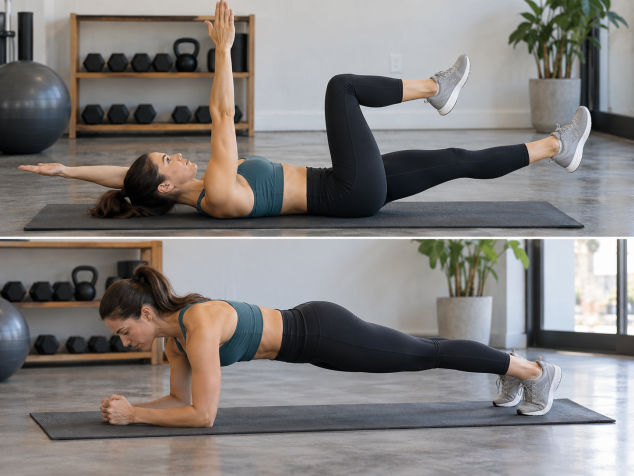
Dead bug vs plank: Which should beginners master first? Learn proper form, core benefits, and a simple weekly workout routine for better stability.
Somewhere along the way, the plank became the unofficial entrance exam for core training. Walk into almost any gym, follow a beginner workout video, or search for the best core exercises for beginners, and there's a good chance someone will tell you to hold a plank for 30 seconds. Meanwhile, the dead bug exercise barely gets the same attention, possibly because its name sounds more like a pest-control problem than a legitimate workout. I've become convinced that we've got the learning order slightly wrong. When comparing dead bug vs plank for beginners, I'd recommend mastering the dead bug first. It teaches you how to brace your abs while your arms and legs move, which is a useful foundation for more demanding core stability exercises. Planks absolutely deserve a place in your routine, especially for developing core endurance. Still, there's something valuable about learning to control your spine while lying on the floor before asking your entire body to maintain that control against gravity.
One reason I rate dead bugs so highly is that they make proper core engagement surprisingly easy to understand. If you're wondering how to do a dead bug correctly, start by lying on your back with your arms pointing toward the ceiling and your hips and knees bent approximately 90 degrees. Keep your lower back in a comfortable, controlled position against or close to the floor, avoiding an exaggerated arch. Gently brace your abdominal muscles as though preparing for someone to poke your stomach, while continuing to breathe. Slowly extend your right arm overhead and your left leg outward, stopping before your torso shifts or your lower back starts lifting excessively. Return to the starting position and alternate sides. The opposite-arm-and-leg movement challenges your abdominal muscles to resist unwanted spinal extension while improving coordination. What I particularly like about dead bug benefits is how quickly poor technique becomes obvious. If your ribs flare upward, your lower back arches, or your leg drops farther than you can control, you've exceeded your current range of motion. Shorten the reach, keep your knees slightly more bent, and slow everything down. Five genuinely controlled repetitions per side can teach you more about abdominal bracing than fifteen rushed ones.
Planks approach core strength from a different angle, and I understand why they've become so popular. They require almost no equipment, take very little space, and can make fifteen seconds feel considerably longer than expected. To perform a forearm plank correctly, place your elbows directly beneath your shoulders, rest your forearms on the floor, and extend your legs behind you with your toes supporting your lower body. Keep your head aligned with your spine, engage your glutes, and brace your abs while maintaining a relatively straight line from your shoulders through your heels. Think about keeping your ribs aligned over your pelvis rather than letting your stomach sink toward the floor. One of the biggest plank exercise benefits is developing isometric core endurance, meaning your muscles maintain tension without repeatedly moving through a range of motion. The familiar mistakes are sagging hips, lifting your backside too high, and holding your breath as the effort increases. I've never understood the obsession with bragging about two-minute planks when the final minute looks like someone desperately trying to avoid touching a hot floor. If a regular plank feels overwhelming, perform it from your knees, keeping your body aligned from head to knees, or elevate your forearms on a sturdy bench. A controlled 15-second hold is a perfectly respectable starting point.
The dead bug vs plank comparison becomes more interesting when you consider what each exercise actually demands from your body. Both are anti-extension core exercises because they train your abdominal muscles to resist excessive arching through the lower back. However, the dead bug introduces movement through your limbs while your torso stays controlled, making it particularly useful for practising spinal positioning and breathing. The plank requires you to support more of your body weight while maintaining tension through your shoulders and trunk. That additional demand is excellent for building full-body stability, although it can make technique harder to manage for someone who hasn't yet learned what a proper abdominal brace feels like. For most beginners, the dead bug is the better first exercise because it allows you to develop core control with less overall loading. Someone who already has decent body awareness from strength training might find planks equally approachable, and comfort matters too. There's also no reason to treat dead bug exercise vs plank benefits as a competition with one permanent winner. I see dead bugs as an opportunity to practise controlled movement and planks as a way to challenge that control under greater physical demand. They complement each other particularly well.
For a beginner core workout routine, I'd keep things manageable with three dedicated sessions per week, scheduled on nonconsecutive days. On Monday, start with two or three sets of five to eight controlled dead bug repetitions per side, followed by two sets of forearm planks held for 15 to 20 seconds each. Rest approximately 30 to 60 seconds between sets, taking longer if you need time to recover your breathing or maintain good form. On Wednesday, repeat the dead bugs with extra attention to slow extensions and controlled exhales. Follow them with two sets of a comfortable plank variation, perhaps from your knees if Monday's full planks were difficult. Friday can combine the same exercises, giving you another opportunity to improve the quality of your repetitions. Once the movements feel comfortable, you can add a repetition per side or extend your plank holds by five seconds. I'd leave Tuesday, Thursday, and the weekend free from additional dedicated core sessions, although walking or your regular strength-training workouts can certainly continue as recovery allows. Training your core approximately three times per week provides regular practice without turning a beginner routine into another major commitment. The entire session can fit into roughly ten minutes, which is one of my favourite things about this combination. You can finish it before you've spent that much time deciding what music to play.
Progression is where I think both exercises become much more interesting, especially once the beginner versions start feeling comfortable. With dead bugs, I would first increase the distance your opposite arm and leg travel while maintaining the same stable torso position. Over several weeks, gradually add controlled repetitions, then consider variations that create a longer lever or require greater coordination. For planks, extend holds in small increments, aiming for 20 to 30 seconds of consistent tension before exploring something more challenging, such as a side plank or a carefully controlled plank with a leg lift. There's little reason to chase a particular endurance record. Watch for the moment your ribs start lifting, your hips change position, or your breathing becomes strained. That's usually a good indication to shorten the movement, reduce the difficulty, or finish the set. Mild muscular effort is expected; sharp or persistent pain is a reason to stop and seek appropriate guidance. I also think these exercises work especially well alongside squats, rows, and other compound strength movements because they reinforce the abdominal control those exercises require. Neither one independently guarantees visible abs, and neither should be treated as a cure for back pain. Their real value comes from improving your ability to manage tension and movement during training.
My final verdict on dead bug vs plank for beginners is pretty straightforward: master the dead bug first, then make the plank a regular part of your core training. The dead bug earns my recommendation because it encourages patience and exposes the little compensations that can go unnoticed when you're concentrating on surviving a plank hold. It's also remarkably easy to adjust for different starting abilities. Once you can move your opposite arm and leg without your torso shifting around, you've developed a useful foundation for tackling planks with greater confidence. And when you do start planking, forget about chasing whatever impressive hold time you've seen someone post online. Fifteen seconds of solid technique deserves more respect than a minute spent gradually collapsing toward the floor. I would happily keep both exercises in a long-term strength routine because their demands remain useful as you progress. If you're starting from scratch, though, my advice is to get comfortable on your back, learn what controlled abdominal tension actually feels like, and earn those longer plank holds one good repetition at a time.
Pros:
Beginner-friendly: Dead bugs are an approachable starting point for learning proper core engagement and spinal control.
Improves core stability: Both exercises strengthen the abdominal muscles responsible for resisting excessive spinal movement.
Develops better body awareness: Dead bugs teach controlled breathing, abdominal bracing, and coordination through opposite-arm-and-leg movements.
Builds core endurance: Planks develop the ability to maintain abdominal tension and a stable body position.
Easy to modify: Both exercises offer beginner-friendly variations and gradual progression options.
No equipment required: Dead bugs and planks can be performed almost anywhere.
Complements strength training: Both exercises help develop trunk control useful during compound lifts and everyday activities.
Cons:
Proper technique takes practice: Beginners may struggle with lower-back arching during dead bugs or sagging hips during planks.
Planks can be demanding: Supporting your body weight may make planks difficult for beginners with limited core strength.
Dead bugs require coordination: Moving opposite limbs while keeping the torso stable can initially feel awkward.
Easy to sacrifice form: Rushing dead bug repetitions or holding planks too long reduces exercise quality.
Limited muscle-building potential: Neither exercise provides the same progressive loading opportunities as more demanding resistance exercises.
Results require consistency: Occasional sets won't produce substantial improvements in core strength or endurance.
Won't automatically reveal abs: Visible abdominal definition depends on factors beyond these exercises, including overall body composition.
Bottom Line:
I'd recommend mastering the dead bug before the plank, especially if you're new to core training. Dead bugs teach abdominal bracing and spinal stability in a controlled position, making them an excellent foundation for more demanding exercises. Planks are still worth learning because they build core endurance and challenge your ability to maintain full-body tension. My preferred approach is to practise both three times per week, starting with slow dead bug repetitions and adding short, properly executed planks. When it comes to building a stronger core, I'd take ten seconds of excellent technique over a minute of struggling through bad form any day.
Tags:
dead bug vs plank, dead bug vs plank for beginners, dead bug exercise, dead bug benefits, dead bug exercise proper form, how to do dead bug, core stability exercises, plank exercise benefits, how to do a plank correctly, best core exercises for beginners