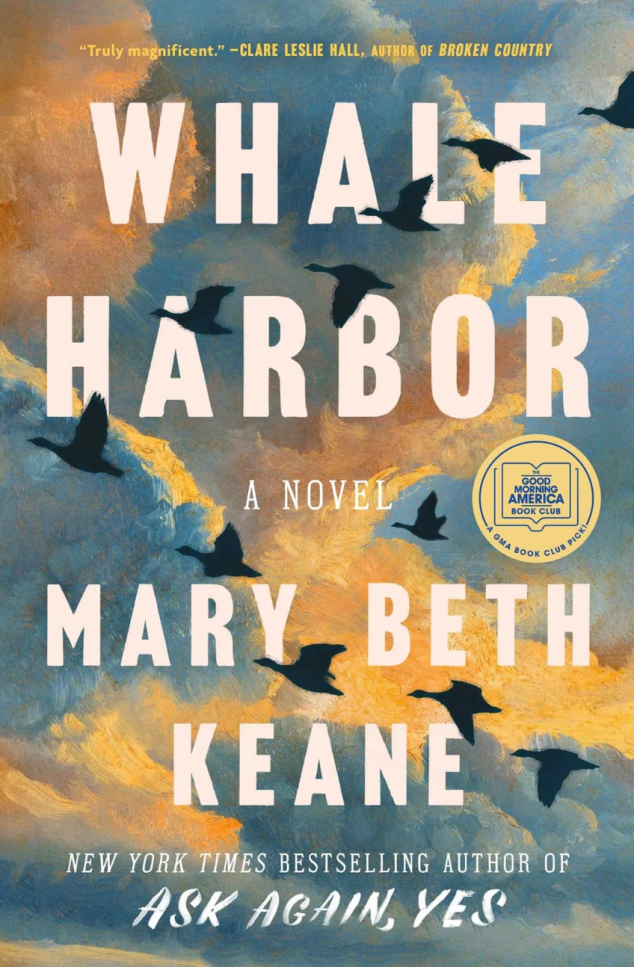
Inspired by her father's Irish upbringing and a painful family separation, Whale Harbor transforms real-life regret into a moving story of brotherhood, guilt, and the decisions that haunt families.
Mary Beth Keane's novel is fiction inspired by her own Irish family history, particularly a younger uncle who ran away and a father who spent decades wondering whether he could have prevented it. That connection makes me more curious about the book than any dramatic plot tease could. Keane has taken a family memory that clearly refused to stay in the past and built a multigenerational story around it. The novel also earned Barnes & Noble's 2026 Book of the Year award, a fitting reason for readers to ask where this particular story began.
Keane's father grew up in an Irish-speaking community in Connemara, on Ireland's western coast, as the second eldest of eleven children. His mother died just weeks after giving birth to the youngest, leaving an infant and ten older siblings in a household suddenly missing its center. Keane has identified that death as one of the two major real-life events that inspired Whale Harbor. I find the scale of that loss difficult to comprehend. Eleven children can sound almost picturesque when introduced as the premise of a sprawling family saga. Then you remember that each of those children needed their mother, and that the older siblings were being pushed toward adult responsibilities much too early.
In 1963, Keane's father, then nineteen, was preparing to emigrate to America. One of his younger brothers desperately wanted to go with him. The boy was too young, so Keane's father promised to send for him after finding steady work and a reliable home in New York. Roughly a year later, the younger brother ran away. Keane has said he was around thirteen, although family recollections differ slightly about his age. It is a painful story precisely because her father's original answer seems understandable. I can picture someone making that promise with every intention of keeping it, never imagining how heavily the words might weigh on him afterward.
Keane discovered just how heavily in 2022, during the final days of her father's life. As his dementia progressed, he sometimes returned to speaking Irish, his first language, which Keane and her sisters could not understand. Visiting uncles translated and explained that he kept returning to the decision he had made back in 1963. According to Keane, she had not appreciated the depth of his guilt until then. That detail stays with me. After a lifetime filled with other experiences, the prospect of having left his brother behind still occupied him. It suggests the kind of private family history that children may know in outline while missing what it cost the people who lived it.
In the novel, Keane reshapes that material around the fictional Joyce family and eleven brothers whose lives branch across Ireland, England and America. Macdara, the second eldest, leaves for work on a Montana ranch; his younger brother Rian asks to come, and Mac promises to bring him over later. Rian's disappearance becomes a lasting source of anguish. Those parallels are deliberate. The characters and their individual stories are Keane's creations. She has explained that no one in her family settled in Montana. An uncle instead worked on Alaska's pipeline, while her father was fascinated by Montana, which helped inspire the fictional destination. Cuan, the novel's Connemara village, also draws on the place her father knew.
What interests me most about the Whale Harbor true story is the way family memory behaves. Keane recalled hearing the death and disappearance discussed at gatherings long before she understood their full significance. In another interview, she noted that relatives even disagreed about whether her uncle was twelve or thirteen when he ran away. That small uncertainty feels revealing. A family can carry the same event for generations while remembering its edges differently. One relative might focus on a practical decision; another might remember the ache of being left behind. Keane has room to imagine those perspectives because she is writing fiction, with freedom to explore grief and loyalty beyond the known facts.
For me, that is what gives Whale Harbor its appeal among multigenerational family novels. Its questions about brotherhood and responsibility grew from a real man's unresolved regret, and its fictional scope lets those questions follow people across decades and borders. Barnes & Noble's recognition certainly adds to its appeal, although literary awards rarely decide my reading list. I am more persuaded by the image of Keane hearing, late in her father's life, about a promise that had never stopped troubling him. Knowing that history makes the novel's concern with separation feel earned. Some family stories seem to demand another telling, even when no one can reconstruct exactly what happened.
Pros:
- Inspired by Mary Beth Keane's real Irish family history, adding emotional depth and authenticity.
- Explores powerful themes of brotherhood, grief, guilt, and family loyalty.
- The story of eleven brothers offers an intriguing multigenerational perspective.
- Examines how seemingly ordinary decisions can affect families for decades.
- Blends historical inspiration with fictional storytelling, giving Keane creative freedom.
- Recognized as Barnes & Noble's 2026 Book of the Year.
Cons:
- The large cast of brothers may make the family relationships difficult to follow.
- Heavy themes involving loss, separation, and regret may feel emotionally demanding.
- Readers looking for a completely factual family history may be disappointed by the fictional elements.
- The multigenerational storytelling may feel slower to readers who prefer fast-paced plots.
- Some readers may want more definitive answers about the real-life events that inspired the novel.
Bottom Line:
I think Whale Harbor becomes considerably more compelling once you understand the real family history behind it. Knowing that Mary Beth Keane's father carried guilt over his younger brother's disappearance for decades gives the novel an emotional foundation that genuinely interests me. The combination of Irish family history, complicated brotherhood, and fictional storytelling makes this an especially appealing choice for readers who enjoy thoughtful, character-driven literary fiction. For me, the most fascinating part is how one painful family memory inspired an entire novel about the consequences of decisions that cannot be undone.
Tags:
is whale harbor based on a true story, whale harbor true story, mary beth keane whale harbor, whale harbor family history, mary beth keane whale harbor inspiration, whale harbor real-life inspiration, whale harbor book review