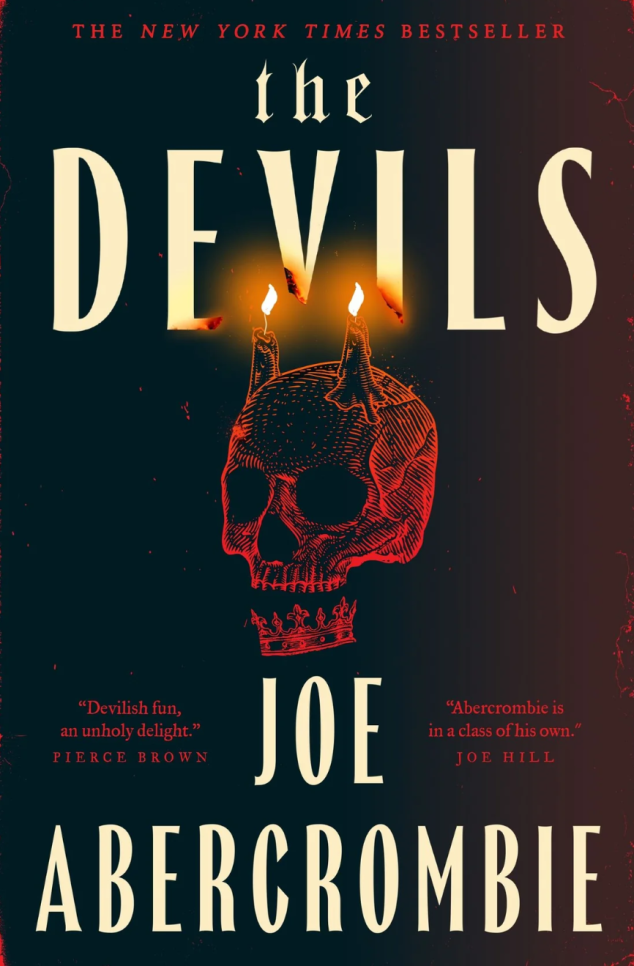
Who are the real devils in Joe Abercrombie's The Devils? Explore how monsters, religious authority, and moral hypocrisy complicate good and evil.
If a religious institution keeps a collection of monsters locked away for its own secret purposes, I immediately start wondering whether the creatures are the ones everyone should fear. That uncomfortable question sits at the heart of The Devils by Joe Abercrombie, a dark fantasy novel with a wonderfully twisted understanding of morality. The Church maintains a secret organization called the Chapel of the Holy Expediency, where supernatural outcasts and convicted criminals are put to work carrying out dangerous assignments. Their latest mission involves escorting a young thief named Alex to Troy, where she is expected to claim an imperial throne. Naturally, the journey becomes spectacularly unpleasant. What fascinated me most, though, was the novel's interpretation of evil. The real devils in The Devils are arguably those who believe their righteous intentions excuse whatever cruelty they choose to inflict. Some have supernatural abilities. Others have respectable titles and considerable religious authority.
Abercrombie makes that distinction increasingly difficult to ignore once you spend time with his wonderfully dysfunctional characters. There's Sunny, an elf whose gentle disposition challenges the terrifying reputation attached to her people. Baron Rikard is a vampire with impeccable manners, which somehow makes his dangerous nature even more entertaining. Then there's Balthazar, a necromancer whose opinion of his own brilliance could probably occupy an entire cathedral. These characters have genuinely disturbing abilities and considerable moral shortcomings, yet their personalities gradually complicate the labels assigned to them. I found Sunny particularly interesting because her existence exposes how easily an entire group can be condemned through inherited prejudice. Meanwhile, the group's violent werewolf, Vigga, makes it impossible to pretend that every misunderstood creature is secretly harmless. Moral ambiguity in The Devils comes from recognizing someone's humanity while remaining fully aware of their capacity for terrible behaviour.
The Church provides the novel's sharpest contradiction. Under Cardinal Zizka's authority, the Chapel of the Holy Expediency operates as a secret instrument of an institution that publicly claims moral legitimacy. The very name made me laugh when I first considered its implications. Apparently, adding "Holy" to "Expediency" makes morally questionable decisions sound considerably more respectable. The Church's condemned monsters become valuable whenever their abilities serve its political and religious objectives, with supernatural members bound to its service. That arrangement raises an uncomfortable question about institutional morality: how much cruelty becomes acceptable when someone powerful declares the objective righteous? Abercrombie gives the Church recognizable motivations within a world threatened by conflict and catastrophe, which makes the ethical problem more interesting. I can understand why its leaders want extraordinary protection. Their willingness to control the creatures they condemn still reveals a disturbing convenience in how they define sin.
Brother Diaz adds a different perspective because he enters this arrangement carrying the expectations of a relatively sheltered monk. He arrives in the Holy City anticipating recognition, only to discover that his new responsibilities involve supervising individuals who could make a respectable monastery deeply reconsider its recruitment policies. His discomfort is frequently hilarious, although I also appreciated the uncertainty beneath it. Diaz has inherited a religious understanding of what constitutes righteousness, and his assignment places that understanding under considerable pressure. Alex creates another interesting complication. As a streetwise thief unexpectedly presented as a potential empress, she makes the connection between social standing and moral worth look rather ridiculous. Watching these characters interact made me increasingly suspicious of anyone who assumes authority automatically comes with wisdom. One of the strongest themes in The Devils is the difference between possessing moral authority and behaving morally. The novel repeatedly invites readers to examine that difference for themselves.
Of course, this is Joe Abercrombie dark fantasy, so nobody gets to contemplate ethical philosophy in peaceful surroundings for very long. Bloodshed has an annoying habit of interrupting the conversation. His sharp dialogue and wonderfully unpleasant sense of humour make the characters' contradictions especially entertaining. Balthazar's wounded professional pride is often hilarious, particularly when his enormous self-regard collides with the indignities of serving the Church. Rikard's cultivated civility produces its own uncomfortable comedy, given what he actually is. I love how Abercrombie allows these personalities to become familiar enough that I catch myself hoping they'll succeed, sometimes immediately after they've behaved appallingly. That emotional contradiction is one of the novel's cleverest effects. Readers become willing to forgive questionable behaviour when they understand a character's fears or enjoy their company. It also makes me wonder how readily we extend similar forgiveness to charismatic people in the real world.
I do think The Devils occasionally leans a little heavily on its chaotic ensemble and the succession of dangers confronting them. Some stretches of the journey follow a familiar rhythm of narrow escapes and violent complications, and the characters' eccentricities can sometimes feel more prominent than their psychological development. For readers who prefer restrained fantasy or a consistently serious treatment of religion, Abercrombie's irreverence may be exhausting. Yet I think the excess serves an interesting purpose. The frightening figures become familiar through their quarrels and occasional vulnerability, while the supposedly respectable world around them grows increasingly troubling. The book's treatment of religion is particularly effective when understood as a criticism of institutional certainty rather than a blanket dismissal of faith. A sincere believer can struggle with conscience, and a powerful institution can use sacred language to defend deeply questionable choices. That distinction gives the story some welcome depth beneath its gleeful brutality.
Ultimately, my interpretation of The Devils title meaning comes down to the danger of believing that goodness is something you possess permanently, regardless of your actions. Abercrombie fills his story with characters whose appearances and reputations encourage immediate judgments, then makes those judgments increasingly uncomfortable. The Church's behaviour suggests that ordinary human ambition can be every bit as frightening as supernatural hunger, especially when power protects it from scrutiny. That idea gives the novel lasting relevance because the temptation to excuse cruelty in service of a supposedly noble goal extends well beyond fantasy. For anyone wondering whether The Devils is worth reading, I'd recommend it enthusiastically to readers who enjoy morally grey characters and humour dark enough to make them feel slightly guilty for laughing. What stayed with me was the suspicion that the most dangerous devil might be the person who has stopped questioning their own righteousness. And in Abercrombie's world, that's a description with far too many potential candidates.
Pros:
Morally complex characters: The supernatural outcasts challenge traditional ideas of good and evil, making their questionable decisions surprisingly relatable.
Clever religious satire: The Church's willingness to exploit creatures it condemns creates an interesting examination of hypocrisy and moral authority.
Dark, sarcastic humour: Abercrombie's sharp dialogue and wicked sense of humour make even the most disturbing situations entertaining.
Memorable supernatural cast: Vampires, werewolves, necromancers, and elves bring distinctive personalities and unexpected emotional depth.
Thought-provoking themes: The story raises compelling questions about who gets to define evil and whether supposedly righteous intentions can excuse cruelty.
Unpredictable character dynamics: Conflicting personalities and shifting sympathies make the unconventional group entertaining to follow.
Cons:
Occasionally excessive violence: The graphic brutality and grim humour may discourage readers who prefer lighter fantasy.
Uneven character development: Some personalities receive more emotional depth than others, leaving certain characters feeling underexplored.
Repetitive action sequences: The constant dangers and narrow escapes can occasionally overshadow the novel's more interesting moral questions.
Large ensemble cast: Keeping track of the characters and their individual motivations can take some effort.
Irreverent religious themes: Readers looking for a serious or sympathetic portrayal of organized religion may find the Church's depiction frustrating.
Bottom Line:
The Devils is a wickedly entertaining dark fantasy that makes you question whether the monsters are actually the worst people in the room. I particularly enjoyed how Joe Abercrombie uses supernatural outcasts and a morally compromised Church to explore hypocrisy, prejudice, and the dangers of unquestioned righteousness. Some of the relentless action feels excessive, but the sharp humour and complicated characters kept me invested. For me, the most fascinating thing about The Devils is how easily I found myself rooting for characters who would be villains in almost any other story. It's an excellent choice for fantasy readers who appreciate morally grey characters and stories that refuse to make good and evil conveniently simple.
Tags:
The Devils, Joe Abercrombie, who are the real devils in The Devils, The Devils title meaning, The Devils themes, The Devils morality, The Devils by Joe Abercrombie review, The Devils book analysis, The Devils character analysis,