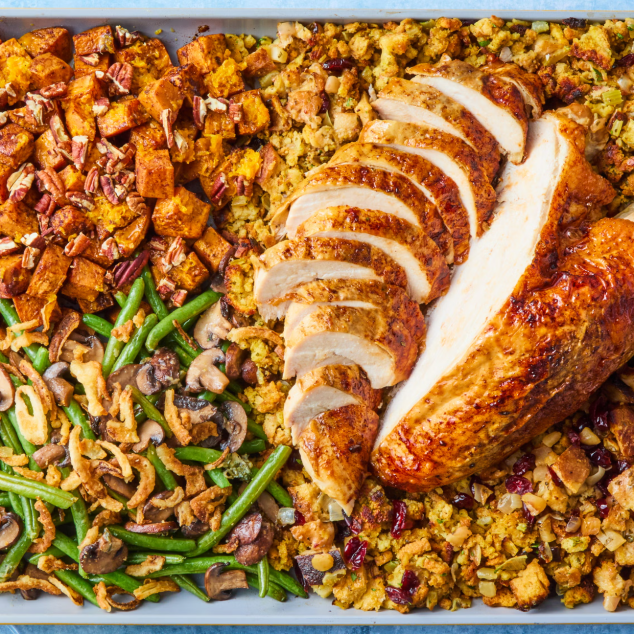
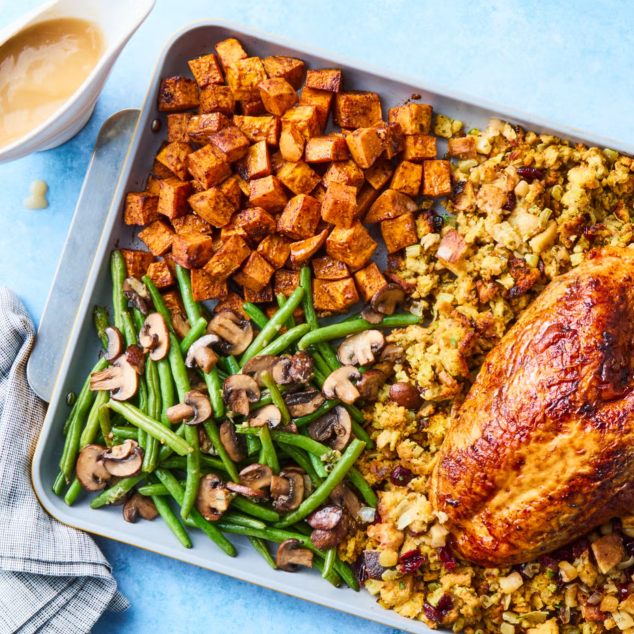
A proper Thanksgiving feast doesn't have to mean spending all day in the kitchen. This sheet-pan dinner brings buttery herb-roasted turkey and classic holiday sides together on one baking sheet, making it perfect for smaller gatherings.
A sheet-pan Thanksgiving dinner is an easy way to prepare a traditional holiday feast by roasting turkey breast and your favourite Thanksgiving side dishes together on a single rimmed baking sheet. The secret is staggering the cooking times so each ingredient finishes at roughly the same time. I love this concept because it makes preparing a proper Thanksgiving dinner feel considerably more manageable, particularly when you're cooking for two to four people. There's something slightly ridiculous about spending six hours preparing dinner for a household of two, especially when the kitchen looks like a disaster zone afterwards. Inspired by Delish's sheet-pan Thanksgiving dinner recipe, I've put together a variation featuring lemon-herb butter turkey, rustic apple and sage stuffing, maple-roasted sweet potatoes and garlicky green beans. It's a complete holiday meal with plenty of familiar Thanksgiving flavours.
The biggest appeal of a one-pan Thanksgiving dinner is how much easier it makes managing the holiday cooking schedule. Anyone hosting Thanksgiving for the first time will appreciate having fewer dishes competing for oven space. Choosing a boneless, skin-on turkey breast weighing approximately 2 to 2½ pounds (900 g to 1.1 kg) provides enough meat for four people or a generous Thanksgiving dinner for two with leftovers. Keeping the skin intact helps protect the meat from drying out, especially when you spread softened herb butter underneath it. I particularly like the combination of lemon zest and fresh thyme with turkey because the citrus adds a little brightness to an otherwise rich holiday meal. For this sheet-pan Thanksgiving dinner recipe, allow approximately 25 minutes for preparation, 60 to 85 minutes for roasting and another 10 to 15 minutes for the turkey to rest.
Begin by preheating the oven to 375°F (190°C) and preparing a large, 18-by-13-inch rimmed baking sheet. Create a sturdy, shallow foil compartment with raised edges at one end to contain the turkey juices. Combine 3 tablespoons of softened unsalted butter with 2 minced garlic cloves and 2 teaspoons of fresh thyme leaves. Add the zest of half a lemon, 1 teaspoon of fine sea salt and ½ teaspoon of freshly ground black pepper. Pat the fully thawed turkey breast dry with paper towels, gently loosen the skin and distribute most of the seasoned butter underneath it. Rub the remaining butter over the surface and place the turkey skin-side up in its foil compartment. Roast for 25 minutes while preparing the side dishes. Giving the turkey a head start allows the skin to begin browning before the vegetables join it. Remember to wash your hands and clean any surfaces or utensils that have come into contact with raw poultry.
For the rustic apple and sage stuffing, combine 4 cups of dried sourdough bread cubes with ½ cup of finely diced yellow onion and ½ cup of chopped celery. Add one small diced Granny Smith apple, 2 tablespoons of melted butter, 1 teaspoon of dried sage and ½ teaspoon of dried thyme. Stir in approximately ¾ to 1 cup of low-sodium chicken broth, adding it gradually until the bread is evenly moistened. Season lightly with salt and pepper. Arrange the mixture in a separate, lightly greased foil compartment on the baking sheet, keeping it relatively shallow so the exposed bread develops crisp edges. For the maple-roasted sweet potatoes, toss 1 pound (450 g) of sweet potatoes, cut into ¾-inch cubes, with 1 tablespoon of olive oil and 1 tablespoon of pure maple syrup. Season with ½ teaspoon of ground cinnamon and a generous pinch of salt. Spread the potatoes in an open section of the baking sheet, leaving room for the green beans. Return the pan to the oven after the turkey's initial 25 minutes of roasting.
After another 20 minutes, toss 8 ounces (225 g) of trimmed green beans with 1 tablespoon of olive oil, ½ teaspoon of garlic powder and a little salt and pepper. Arrange them in the remaining space and continue roasting for approximately 15 to 20 minutes, checking each component as it approaches doneness. Turn the sweet potatoes once during cooking to encourage caramelization. The stuffing should take roughly 35 to 45 minutes in total, while the green beans should remain slightly firm with lightly blistered edges. Turkey and vegetables can safely cook together on the same baking sheet when raw poultry juices are properly contained and everything is cooked thoroughly. Use a meat thermometer to confirm that the thickest part of the turkey breast and the centre of the stuffing have both reached 165°F (74°C). This stuffing temperature is particularly important if it has been exposed to poultry drippings. Remove individual components as they finish using clean utensils, loosely tent the turkey with foil if the skin becomes too dark, and allow the fully cooked breast to rest for 10 to 15 minutes before slicing.
Another reason I think this is such a useful small Thanksgiving dinner idea is that much of the preparation can happen the evening before. The bread can be cubed and dried, the vegetables chopped and refrigerated, and the herb butter prepared ahead of time. You can even season the turkey breast the previous evening and keep it covered in the refrigerator. I recommend waiting until shortly before cooking to add the broth to the stuffing, which helps prevent the bread from becoming overly soft. Serve everything with a generous spoonful of cranberry sauce and some warm turkey gravy. Good-quality store-bought gravy is perfectly acceptable here, especially if keeping the cooking simple is your priority. Refrigerate leftovers in shallow containers within two hours, enjoy them within two to three days or freeze them for later. Reheat leftovers to 165°F (74°C).
What makes sheet-pan Thanksgiving dinner worth keeping in your annual holiday cooking routine is how well it suits everyday households. A few slices of buttery turkey alongside caramelized maple sweet potatoes and a helping of crisp-edged sourdough stuffing would satisfy pretty much everything I look forward to eating at Thanksgiving. The apple adds a pleasant tartness to the stuffing, while the green beans give the plate some freshness. I'd happily recommend this approach to couples, smaller families and anyone who wants to enjoy a traditional Thanksgiving meal without sacrificing most of the holiday to cooking. It also strikes me as a great excuse to make a Thanksgiving-style dinner on an ordinary autumn weekend. Surely there's no reason good turkey and stuffing should be reserved exclusively for special occasions.
Pros:
- Significantly less preparation and cleanup than a traditional Thanksgiving dinner.
- Ideal for couples, small families and intimate holiday gatherings.
- Makes coordinating turkey and side dishes much easier.
- Requires minimal cookware and oven space.
- Retains the familiar flavours of a traditional Thanksgiving feast.
- Reduces unnecessary food waste and excessive leftovers.
- Several ingredients can be prepared the night before.
- Easily customizable with different seasonal vegetables and seasonings.
Cons:
- Limited baking sheet space makes it unsuitable for larger gatherings.
- Cooking times require careful coordination.
- Overcrowding can prevent vegetables from caramelizing properly.
- Turkey breast can dry out if overcooked.
- Requires careful management of raw poultry juices to prevent cross-contamination.
- Offers less variety than a conventional Thanksgiving spread.
Bottom Line:
I think sheet-pan Thanksgiving dinner is a fantastic option for anyone who loves traditional holiday food but finds the preparation exhausting. Buttery herb-roasted turkey and crisp-edged stuffing are every bit as appealing when prepared on a smaller scale. With some thoughtful preparation and a reliable meat thermometer, this easy Thanksgiving dinner could easily become an annual holiday tradition worth keeping.
Tags:
sheet pan thanksgiving dinner, one pan thanksgiving dinner, easy thanksgiving dinner, sheet pan thanksgiving dinner recipe, thanksgiving dinner for two, thanksgiving dinner for four, small thanksgiving dinner ideas, sheet pan turkey breast