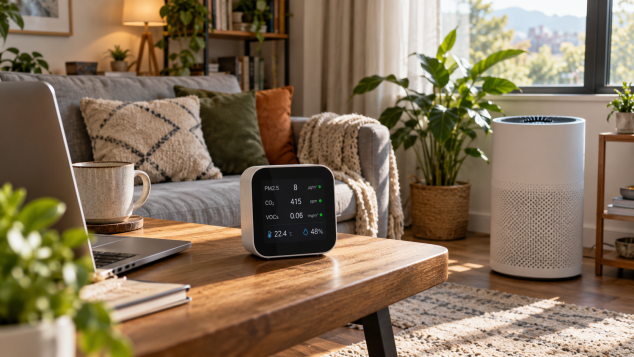
Air quality monitor vs air purifier: discover how each works, which features matter, and whether your home needs one, both, or neither.
We check outdoor air quality before going for a run, worry about wildfire smoke drifting into the neighbourhood, and occasionally glance at the air quality index on our phones. Then we head indoors, close the windows, and assume everything is fine. I've always found that a little strange, especially considering how much time we spend at home. Cooking fumes, household dust, and whatever the dog brought in can all affect the air we're breathing. That's partly why indoor air quality monitors and air purifiers have become such interesting additions to the smart home category. Both promise to help us understand or improve our indoor environment, although they serve very different purposes. An air quality monitor measures certain pollutants and environmental conditions, while an air purifier filters contaminants from the air. When comparing an air quality monitor vs air purifier, I think the smartest purchase depends on the problem you're actually trying to solve. For someone dealing with airborne allergens or wildfire smoke, I'd lean toward a purifier first. If the concern is mysterious stuffiness or questionable ventilation, a monitor might reveal something more useful. And for plenty of households, buying neither is a perfectly reasonable decision.
An indoor air quality monitor is essentially a collection of miniature sensors housed inside a device that displays information about the surrounding air. The most interesting feature, in my opinion, is a PM2.5 sensor. PM2.5 refers to fine particulate matter measuring 2.5 micrometres or smaller, including particles produced during cooking and those carried indoors by wildfire smoke. Some fine particles can also become airborne when household dust is disturbed. Their small size matters because they can travel deep into the respiratory system. Consumer PM2.5 sensors commonly use optical technology, detecting light scattered by airborne particles to estimate their concentration. It's clever technology, although readings can be affected by humidity, particle composition, and sensor quality. The Environmental Protection Agency explains that low-cost monitors can provide useful information while having limitations in measurement accuracy. That's why I'd treat a smart air monitor as a tool for spotting meaningful changes over time rather than expecting laboratory-level precision. A sudden increase after frying dinner is worth noticing, even if the displayed number isn't perfectly accurate. What I wouldn't trust is a mysterious green "excellent air quality" indicator without knowing what the device actually measures.
Carbon dioxide monitoring is another feature I find genuinely useful, particularly for anyone spending eight hours in a home office or sleeping with the bedroom door closed. A CO2 monitor for home use can help reveal patterns associated with insufficient fresh-air ventilation. As people breathe, indoor carbon dioxide concentrations tend to increase, especially in occupied rooms with limited outdoor air exchange. If ventilation is the main concern, I'd specifically look for an NDIR sensor, which measures CO2 through infrared light absorption. Some inexpensive indoor air quality sensors display estimated CO2, often labelled eCO2, calculated from other gas readings. Those estimates can be misleading when you're trying to judge ventilation. CO2 readings also require context because occupancy and sensor placement affect the results. Volatile organic compound sensors are interesting for different reasons. VOCs can come from cleaning products, fresh paint, and scented household products. Consumer VOC sensors usually provide broad measurements or estimates of total VOC activity, with varying sensitivity to different chemicals. They generally cannot identify individual compounds or establish whether a particular exposure is dangerous. Add temperature and humidity measurements, which can help flag uncomfortable or excessively damp conditions, and a well-equipped monitor becomes quite informative. I particularly appreciate a readable digital display and historical data logging through a mobile app. Wi-Fi connectivity and customizable alerts are convenient, although I'd happily sacrifice elaborate smart home integrations for better sensors and dependable readings.
An air purifier for home use has a more straightforward job: pull room air through a filtration system and send cleaner air back out. For airborne particle pollution, a properly sized HEPA air purifier is one of the more practical consumer electronics purchases. HEPA filtration captures particles such as pollen, smoke particles, and airborne pet dander as air passes through the filter. It can also reduce airborne dust, although settled dust still needs regular cleaning. The important distinction is that filtration performance depends on how much air the machine actually processes. A tiny purifier with a premium-looking design won't accomplish much in a large living room if its airflow is inadequate. Activated carbon filters introduce another capability by adsorbing certain gases and odour-causing compounds. However, the amount of carbon matters considerably. A thin carbon-coated sheet may offer limited gas removal compared with a substantial bed of activated carbon, and the media eventually needs replacing. The EPA specifically recommends considering sufficient carbon material when choosing a purifier for gases. One limitation deserves particular attention: ordinary HEPA air purifiers do not remove CO2 or provide fresh-air ventilation. That beautifully designed purifier humming beside your bed could reduce airborne particles while doing very little about the carbon dioxide accumulating in a poorly ventilated room.
So which device deserves a place in your home? I think the answer becomes much easier when you consider everyday situations. Someone working from home who suspects their office has inadequate ventilation would benefit more from a dedicated CO2 monitor, particularly if the room regularly feels stale after several hours. A household struggling with seasonal allergies or airborne pet dander has a stronger reason to purchase an air purifier because filtration can directly reduce those particles. Living somewhere affected by wildfire smoke makes a capable HEPA purifier especially appealing, with a PM2.5 monitor providing additional information about indoor conditions. For someone interested in smart home air quality, a monitor with useful trend graphs can be fascinating. You might discover that frying breakfast affects your PM2.5 readings far more dramatically than expected. Still, I think there's a danger of becoming obsessed with numbers that offer little practical guidance. I've seen enough smart home gadgets promising detailed analytics to know that more information isn't automatically more useful. If your bedroom feels stuffy, checking CO2 levels and investigating airflow makes more sense than immediately buying another fan-driven appliance. Purchase price matters here, too. A monitor generally has relatively low ongoing costs, while an air purifier needs electricity and recurring filter replacements. Monitoring accuracy also varies between products, so paying more for an impressive screen doesn't guarantee more dependable measurements.
Shopping for either device requires a little attention to details that rarely appear in the glamorous product photographs. For an air quality monitor for home use, I'd prioritize clearly documented sensor specifications, an easily readable screen, and reliable data logging. USB-C power is convenient for a permanently positioned desktop monitor, while rechargeable batteries make sense if you want to compare different rooms. A desktop stand or wall mount can make placement easier, provided airflow around the sensors remains unobstructed. Check whether the companion app works with your phone, whether historical readings can be exported, and whether the sensors need periodic calibration. For an air purifier, I'd look at the Clean Air Delivery Rate (CADR) before getting distracted by touchscreen controls. CADR measures particle-cleaning performance, and a higher rating generally means faster filtration. As a practical reference, the Association of Home Appliance Manufacturers recommends a smoke CADR of at least two-thirds of a room's area in square feet for typical eight-foot ceilings, with a higher target for wildfire smoke conditions. Also consider noise levels at the fan speed you'll actually tolerate, electricity consumption, and whether replacement HEPA filters remain readily available. Cleanable pre-filters can help manage larger debris, while filter replacement indicators are genuinely convenient. Automatic fan modes and app controls have their appeal, but I'd prioritize reliable filtration over features that turn a simple appliance into another complicated smart home project.
Owning both an air quality monitor and an air purifier starts to make sense when you're dealing with a recurring particle pollution problem and want a better understanding of how well your solution is working. A monitor equipped with a PM2.5 sensor can help reveal how particle concentrations change after cooking, during smoky outdoor conditions, or while a purifier operates. Historical readings are especially useful because you can compare patterns across different days instead of relying on one reassuring number. There's a small catch, though. Sensor placement can dramatically influence the results. Put a monitor directly beside a purifier's clean-air outlet and you might get readings that make the machine look extraordinarily effective, even when other parts of the room have higher particle concentrations. The EPA recommends positioning indoor sensors in representative locations, away from air cleaners and other influences that could distort measurements. I'd also avoid treating one before-and-after comparison as a scientific performance test because ventilation changes and other particle sources can influence the results. Some modern purifiers already include built-in particle sensors, automatic fan adjustments, and air quality displays. For most casual users, those features may eliminate the need for a dedicated PM2.5 monitor. A separate device becomes more worthwhile when you want independent measurements, better historical data, or CO2 information that the purifier cannot provide.
There's also something refreshing about admitting that a home doesn't necessarily need another connected electronic device. You may need neither an air quality monitor nor an air purifier if you have no specific monitoring or filtration need and you're already taking sensible steps to manage indoor pollution. Using an effective range hood that vents outdoors while cooking, controlling pollution sources, and improving ventilation when outdoor air conditions permit can make a meaningful difference. Maintaining suitable indoor humidity also helps address moisture-related concerns. Of course, an absence of noticeable problems doesn't prove the air is free of pollutants, and ordinary smart air monitors don't replace dedicated carbon monoxide alarms or appropriate radon testing. My personal verdict is fairly simple: for a typical household with a known airborne particle problem, I'd spend money on a properly sized HEPA air purifier before buying a standalone monitor. If ventilation is the concern, an NDIR CO2 monitor makes more sense as the first purchase. Both devices are worthwhile when regular particle monitoring will help you make better decisions about filtration. Otherwise, I'd save the money until there's a clear reason to spend it. I genuinely like the technology behind these devices, especially the idea of seeing invisible changes in indoor air conditions. But my favourite smart home products are the ones that earn their place long after the novelty of checking an app has worn off.
Pros:
Better awareness of indoor air quality: Monitors can reveal changes in PM2.5, CO2, humidity, and other measurable conditions.
Effective particle removal: HEPA air purifiers can reduce airborne dust, pollen, pet dander, and smoke particles.
Useful smart home features: Real-time readings, mobile alerts, and historical data help identify indoor air quality patterns.
Improved ventilation awareness: CO2 monitors can help identify rooms that may need better airflow.
Complementary benefits: Using both devices allows you to monitor airborne particles and observe how effectively a purifier reduces them.
Options for different needs: You can choose a device based on allergies, wildfire smoke, ventilation concerns, or personal interest in indoor air quality.
Cons:
Additional expenses: Buying both devices can be costly, especially when factoring in replacement filters.
Ongoing maintenance: Air purifiers require regular filter changes, while some monitors need calibration or sensor maintenance.
Sensor accuracy varies: Consumer air quality monitors may provide estimates that don't always reflect precise pollutant concentrations.
Limited filtration capabilities: Ordinary HEPA air purifiers cannot remove CO2 or correct inadequate ventilation.
Potentially unnecessary technology: Homes without a specific air quality concern may gain little practical value from either device.
Noise and energy consumption: Air purifiers use electricity and can be distracting at higher fan speeds.
Bottom Line:
For most households with a known airborne particle problem, I'd choose a HEPA air purifier first. It actively reduces airborne contaminants, making it particularly useful for allergies, pet dander, and wildfire smoke. An indoor air quality monitor is worth considering when you want to understand ventilation problems or track pollution patterns. Owning both makes sense if you have recurring concerns and want to measure how well your purifier is performing. Otherwise, I'd skip the extra gadget and invest in better ventilation and basic indoor air quality habits.
Tags:
air quality monitor vs air purifier, indoor air quality monitor, air purifier for home, air quality monitor for home, HEPA air purifier, smart air monitor, air purifier vs air quality sensor, CO2 monitor home, PM2.5 sensor, indoor air quality sensor