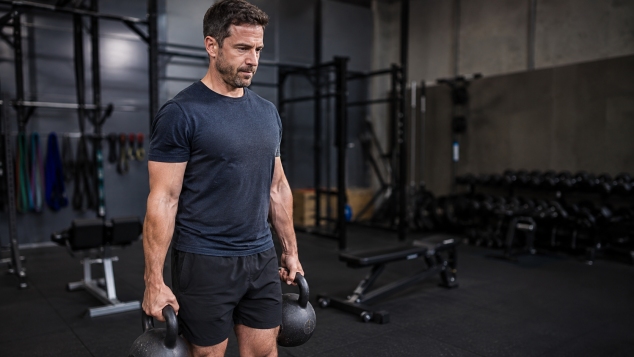
Grip strength offers a useful snapshot of functional strength, especially how well you can hold, carry, and control weight. Training it can also make everyday tasks and common lifts feel more secure.
For years, I treated grip strength as something that was supposed to improve automatically if I kept lifting. Deadlift enough weight, do enough rows and pull-ups, carry heavy dumbbells around the gym, and surely my hands would figure out the rest. What changed my mind was noticing how often my grip was actually deciding when a set ended. My back still had more to give on rows, yet my hands were opening. A heavy deadlift felt less secure because the bar was starting to slip. Once I started training my grip more deliberately, I also noticed surprisingly ordinary benefits, including grocery bags feeling easier to carry from the car. So what does grip strength tell you about your overall fitness? Grip strength can provide useful information about muscular strength and functional capacity, especially your ability to hold, carry, pull, and control weight. It is one useful fitness marker, and it becomes more informative when considered alongside the rest of your strength and physical performance.
Grip strength itself has a fairly specific meaning when it is formally tested. A handgrip dynamometer measures the maximum force you can produce while squeezing, giving researchers and clinicians a simple way to assess muscle strength. That simplicity is one reason grip strength and health have been studied so extensively. Research has associated lower handgrip strength with poorer physical function, disability, and several adverse health outcomes, particularly in older populations. Reviews also caution that the evidence is largely observational, so these relationships do not prove that strengthening your hands directly prevents disease or extends your life. Grip strength is also used in clinical approaches to age-related muscle weakness, while physical performance and muscle quantity provide additional information. What does grip strength indicate? It indicates part of your muscular capacity and gives a practical snapshot of how well you can generate and maintain force through your hands and forearms. Searching for “grip strength by age” can be useful for context, although meaningful comparisons require appropriate reference data because results vary with age, sex, body size, and testing methods.
Where grip strength becomes especially interesting to me is outside a dynamometer test. Functional strength constantly asks you to keep hold of something while the rest of your body does the work. Carrying luggage through an airport, moving a heavy box, hauling bags up a flight of stairs, or opening a stubborn jar all involve the hands transferring force to an object. The same thing happens under a barbell. Your legs and posterior chain may be strong enough for a Romanian deadlift, yet that strength is less useful during the exercise when your hands cannot keep the bar secure. Pull-ups and rows expose the same problem quickly. Is grip strength a good measure of overall fitness? It is a useful measure of one important part of overall fitness, especially muscular and functional strength, although cardiovascular fitness, mobility, lower-body performance, and other abilities need their own measures. Research in older adults helps explain the broader interest: handgrip strength is widely studied because it is inexpensive, portable, and associated with physical function, although reviews have found that it cannot reliably stand in for every aspect of total-body strength or performance.
My preferred beginner approach to grip strength training is two short sessions each week, added to workouts I am already doing. Day 1 is my carry-and-pull day. I would start with farmer's carries for 3 sets of 30 to 45 seconds, using dumbbells or kettlebells heavy enough to demand attention while still allowing an upright torso and controlled walking. Farmer's carries for grip strength work because the hands have to maintain a strong support grip under continuous load instead of producing one quick squeeze. Follow those with dumbbell or cable rows for 3 sets of 8 to 12 reps. Rows train the back while teaching the hands to stay connected to resistance throughout repeated pulling. Finish with dead hangs for 2 to 3 sets of 15 to 30 seconds. Dead hangs for grip strength are simple and humbling because your fingers have to support your body weight continuously. Beginners who cannot comfortably hang for that long can use assistance or shorter holds rather than forcing ugly, painful reps. I like this session because the grip work has a purpose throughout the workout instead of feeling like a collection of random forearm exercises.
Day 2 is my heavier hold-and-upper-body session. Start with Romanian deadlifts for 3 sets of 6 to 10 reps, choosing a weight you can control through the entire range while maintaining your grip. The bar creates a sustained challenge for the hands while the hips and posterior chain handle most of the movement. Next, perform pull-ups, assisted pull-ups, or lat pulldowns for 3 sets of 6 to 12 reps. Pick the variation that allows clean repetitions because hanging onto a bar while pulling repeatedly develops grip endurance alongside upper-body strength. Finish with plate pinches or heavy dumbbell holds for 2 to 3 sets of 20 to 30 seconds. Plate pinches deserve a place here because they ask more from the thumb and fingers than a conventional closed-hand dumbbell grip. Heavy dumbbell holds are the easier alternative to set up: stand tall, hold a challenging pair of weights at your sides, and resist the temptation to shorten the set by leaning or letting the handles roll into your fingertips. With either option, I want the final seconds to feel demanding while my position still looks controlled.
The biggest beginner mistake I see with grip strength exercises is assuming that hands and forearms should be hammered every day because they are relatively small. Your grip is already working during plenty of normal strength training, and excessive fatigue has a way of showing up exactly when you do not want it. A hard grip session the day before deadlifts can turn your hands into the limiting factor long before your posterior chain is challenged properly. I would leave recovery between dedicated sessions and start with weights that allow good posture, smooth reps, and secure holds. Progressive overload can come from adding a little weight, extending a hold, carrying the same load farther, or simply controlling a previously shaky set more confidently. Straps also have a legitimate place in a strength program. If my grip has reached its limit during a heavy row or Romanian deadlift while the muscles I actually want to train still have plenty left, I am comfortable using straps for later sets. They let the larger target muscles receive enough work while grip strength training can continue separately.
How can beginners improve grip strength? Start by practicing loaded carries, hanging, pulling movements, and controlled holds about twice per week, then increase the challenge gradually as your hands adapt. You do not need an entire forearm day or a drawer full of grip gadgets. I have found more value in getting better at holding onto real loads during exercises that already belong in a sensible strength program. That is ultimately why grip strength earned a permanent place in mine. It tells me something useful about whether the strength I am building can actually be transferred through my hands when I lift, carry, or pull something. Research on grip strength and healthy aging makes that ability especially interesting over the long term, while the evidence also supports keeping the measurement in perspective. Grip strength is a valuable signal of functional strength and muscular capacity. For me, the best reason to train it is even simpler: when my grip gets stronger, more of the strength I already have becomes usable.
Pros:
- Simple, practical marker of functional strength
- Can improve performance in deadlifts, rows, pull-ups, and carries
- Carries over well to everyday tasks like lifting bags and moving objects
- Easy to train with basic gym equipment
- Grip strength is associated in research with broader physical function and healthy aging
- Progress can be measured through heavier loads, longer holds, or better control
Cons:
- Grip strength alone does not measure overall fitness
- Overtraining the hands and forearms can interfere with other strength workouts
- Grip can become the limiting factor before larger muscle groups are fully challenged
- Results vary by age, body size, sex, and testing method
- Dedicated grip work may be unnecessary for beginners already doing plenty of pulling and carrying exercises
Bottom Line:
Grip strength is worth paying attention to because it reflects a very practical form of strength that shows up both in the gym and everyday life. I see it as a useful piece of the overall fitness picture, especially when trained a couple of times per week without allowing grip fatigue to compromise the rest of your program.
Tags:
grip strength, grip strength and health, grip strength and overall fitness, what does grip strength tell you, how to improve grip strength, grip strength exercises, grip strength training, functional strength exercises