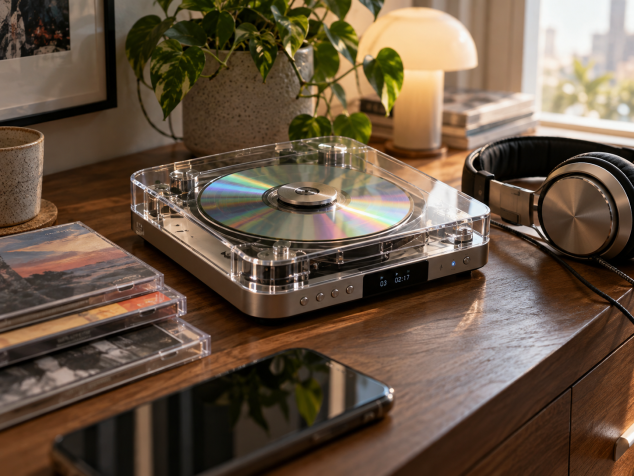
Modern CD players are making a surprisingly stylish comeback, with transparent designs, Bluetooth connectivity, and modern audio features bringing fresh appeal to physical music.
There's something unexpectedly satisfying about watching a CD spin inside a beautifully designed transparent player. It's the kind of gadget that would immediately catch my attention on someone's desk, probably before I'd notice their expensive monitor or custom mechanical keyboard. The modern CD players I've been looking at have very little in common with the chunky portable models that used to live in backpacks, complete with scratched plastic lids and headphones that somehow always tangled themselves. Today's versions look like thoughtfully designed pieces of audio equipment. Some display the entire spinning disc through a clear housing, while others resemble minimalist desktop accessories that could sit comfortably beside a laptop. I've developed a particular appreciation for technology that makes its mechanical workings visible, and a transparent CD player scratches that itch perfectly. There's something appealing about seeing an actual piece of music being played, especially when so much of our listening now happens through invisible files and streaming apps.
The interesting part is that the CD player comeback has some genuine momentum behind it. According to the Recording Industry Association of America, U.S. CD revenue increased 58.6% during the first half of 2026 compared with the same period in 2025. Tom's Hardware highlighted the figures as part of a broader renewed interest in physical music formats, although streaming continues to account for the overwhelming majority of recorded music revenue. So, are CDs coming back? There's reasonable evidence of growing interest, even if streaming remains firmly established as the everyday listening option for most people. I think that renewed curiosity makes sense alongside the appeal of wired headphones, dedicated MP3 players, and other retro audio technology. There's a certain satisfaction in having a device designed around one specific activity. A dedicated CD player gives listening to an album a little more significance, especially when your phone is constantly competing for attention with notifications and whatever else happens to be happening online.
What makes modern CD players particularly interesting is how creatively manufacturers are rethinking their appearance. Transparent CD players are easily my favourite variation because they turn the disc itself into part of the design. Japanese audio brand km5, for example, offers the Instant Disc Audio CP1 Clear, which uses a transparent polycarbonate housing and can be displayed with optional wall-mounting or stand accessories. It also incorporates a rechargeable battery and Bluetooth connectivity. Wall-mounted CD players are especially appealing for smaller spaces, where a spinning album can become an interesting piece of wall decor, although a visible power cable or awkward disc-loading mechanism could spoil the effect. Minimalist desktop players make more practical sense for someone who listens while working, while contemporary portable CD players offer familiar controls in more compact bodies. Personally, I'd lean toward a transparent desktop model with a stable base and straightforward access to the disc. Good design should make everyday use enjoyable, and having to wrestle with a delicate lid every time I change albums would get old quickly.
Bluetooth connectivity is probably the biggest convenience feature separating many modern CD players from their older counterparts, although it's worth understanding exactly what you're buying. A Bluetooth CD player with transmission capability can send music directly to compatible wireless headphones or a Bluetooth speaker, making it possible to enjoy physical albums without running an audio cable across the desk. Bluetooth reception is a different feature: it allows a device to receive audio from something like a smartphone, usually for playback through the player's own speakers or connected equipment. Manufacturers don't always offer both functions. The FiiO DM13 illustrates why checking individual specifications matters, since Bluetooth-equipped versions support wireless transmission, including aptX HD, while the standard version lacks Bluetooth transmission. Wireless audio is convenient, but codec compatibility can affect sound quality, and Bluetooth can introduce some latency. I'd happily use wireless speakers for casual listening, although I'd still want a proper headphone jack. Having both options makes a modern CD player considerably easier to live with.
Wired headphones are actually one of the strongest reasons I'd consider buying a dedicated CD player. A good pair connected through a suitable headphone output offers a direct listening experience without Bluetooth's usual audio re-encoding, wireless interference, or the inconvenience of charging another accessory. The quality of the player's digital-to-analog converter, or DAC, also matters because it converts the digital information stored on the CD into an analog signal that headphones or traditional speakers can reproduce. Of course, the amplifier circuitry and headphones influence the result, too. For a desktop listening setup, I'd look for a proper line output that could connect to powered bookshelf speakers or an existing stereo amplifier. Some better-equipped players also provide optical or coaxial digital outputs for use with compatible amplifiers or external DACs. FiiO's DM13, for example, offers digital outputs alongside its analog connections. One detail I'd double-check is whether a USB-C port supports charging, external power, or additional data functions, since the connector's presence alone doesn't guarantee all those capabilities. A player with excellent connectivity could remain useful long after its visual novelty wears off.
Then there's the question of CD sound quality vs streaming, which deserves a little perspective. Standard audio CDs contain uncompressed 16-bit/44.1 kHz stereo PCM audio, a format capable of excellent sound reproduction. Streaming quality varies considerably depending on the platform, subscription, playback settings, and connected equipment. Apple Music offers lossless audio, and Spotify Premium also supports lossless FLAC streaming, so a CD doesn't automatically offer better fidelity than a properly configured streaming setup. Different album masters can make a meaningful difference as well. For me, the more interesting part of CD vs streaming is the experience of owning the music. Buying a favourite album means having a physical copy with its artwork and liner notes, something that remains playable without an active music subscription. I like the idea of choosing an album from a shelf, putting it into the player, and listening to it from beginning to end. There's even something satisfying about reading the booklet while the album plays. Streaming is wonderfully convenient for discovering new music, and a physical music collection gives particular favourites a more permanent place in everyday life.
Of course, the practical drawbacks deserve attention before anyone starts building an elaborate CD listening station. CDs take up space, buying albums can become expensive, and carrying a stack of discs is considerably less convenient than loading playlists onto a phone. Modern portable CD players also vary widely in build quality and battery performance. If I were shopping for one, I'd prioritize reliable disc reading, sturdy controls, and compatibility with the headphones or speakers I already own. Anti-skip protection is worth checking on a portable CD player because it buffers audio to help prevent interruptions from movement. Battery operation is useful away from a desk, while USB-C charging makes life easier when supported. Buyers should also check whether a player handles CD-R, CD-RW, or MP3-encoded discs, since playback compatibility isn't universal. As for CD player accessories, I'd happily invest in a compact storage rack and protective jewel cases or sleeves to keep discs organized and minimize scratches. An attractive album display could make the setup feel more personal, while a headphone stand would keep everything tidy. I'd also check the availability of replacement power adapters, particularly for an unusual desktop model that might become difficult to service later.
What I find most appealing about modern CD players is how naturally they fit into the growing interest in making everyday technology enjoyable to use. A beautifully designed CD player could sit beside a pair of quality bookshelf speakers in the living room or become a permanent feature of a carefully arranged workspace. I'd personally choose a transparent model with dependable wired audio connections, Bluetooth transmission as a welcome extra, and enough build quality to handle years of regular listening. I'd rather have a smaller collection of albums I genuinely enjoy than an entire wall of discs purchased for decoration, although I can certainly understand the temptation to collect them. For someone who already owns CDs, a modern player could be a particularly satisfying way to rediscover them. It would also make an interesting gift for a music enthusiast who appreciates unusual gadgets. Ultimately, the appeal is surprisingly simple: putting on an album becomes a small occasion again. And if I get to watch the disc spinning through an elegantly designed transparent case while listening, that's a little piece of technology I'd be delighted to make room for.
Pros:
Stylish modern designs: Transparent housings, minimalist desktop models, and wall-mounted players make CDs visually appealing again.
Physical music ownership: Enjoy a permanent collection of favourite albums without relying on streaming subscriptions.
Excellent audio quality: CDs deliver uncompressed 16-bit/44.1 kHz audio, providing consistently high-quality playback.
Modern connectivity: Select models offer Bluetooth transmission, USB-C power, and connections for external speakers.
More intentional listening: Choosing a disc encourages listening to complete albums with fewer digital distractions.
Wired headphone compatibility: A direct wired connection can provide excellent sound without Bluetooth compression.
Unique display appeal: Album artwork and visible spinning discs add personality to a desk or entertainment setup.
Cons:
Additional expense: Purchasing a quality CD player and building a physical music collection can get expensive.
Limited portability: Carrying CDs is less convenient than having an entire music library on a smartphone.
Inconsistent features: Bluetooth support, headphone outputs, rechargeable batteries, and audio connections vary between models.
Storage requirements: CDs need physical space and protective storage to prevent damage.
No guaranteed sound advantage: Modern lossless streaming services can deliver audio quality comparable to CDs.
Build quality concerns: Some design-focused players may prioritize appearance over durability or audio performance.
Bottom Line:
Modern CD players are one of my favourite unexpected comebacks in consumer electronics. I love the combination of transparent designs, physical album ownership, and modern audio connectivity. Streaming will remain my everyday choice for convenience, but there's something genuinely appealing about selecting a favourite CD and enjoying the entire album through a dedicated player. For music lovers who appreciate thoughtful design and collecting physical media, a modern CD player is absolutely worth considering.
Tags:
modern CD players, CD player comeback, Bluetooth CD player, transparent CD player, modern CD players with Bluetooth, best features of modern CD players, portable CD player, CD vs streaming, CD sound quality vs streaming, physical music collection